



A Discovery That Bends the Rules
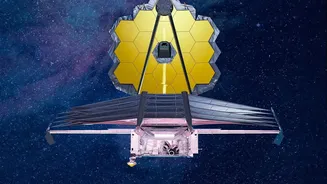
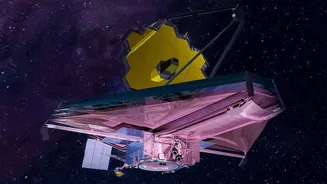
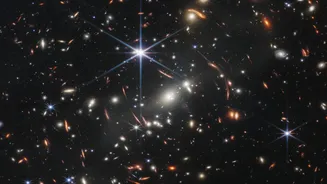
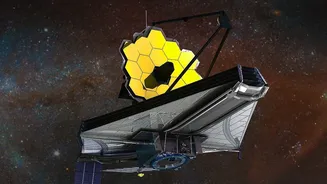
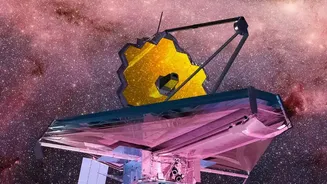
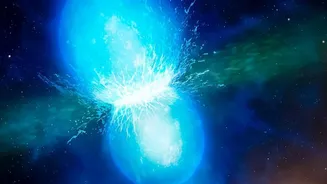
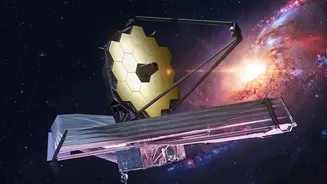
Astronomers using the JWST, in conjunction with the Gemini North telescope in Hawai'i, have identified the oldest and most compact pair of quasars ever seen. Designated J1602+4228AB, the system is so ancient we are seeing it as it was only 900 million
years after the Big Bang. Inside this system are two supermassive black holes, one weighing 1.5 billion times the mass of our sun, the other 400 million times. The problem? According to current cosmological models, they shouldn't exist. There simply hasn't been enough time for them to grow so enormous, so early in the universe's history. As one scientist put it, there is no definitive theoretical explanation for how even a single one of these giants could exist so early, let alone two of them together.
What Exactly is a Quasar?
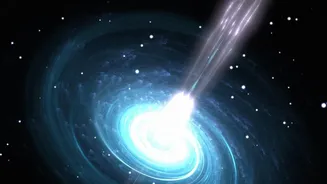
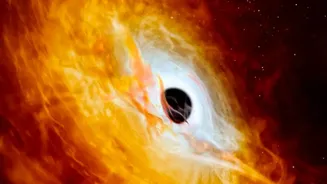
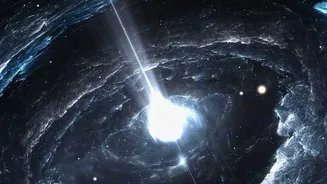
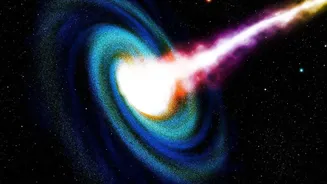
To grasp the significance of this finding, it’s essential to understand what a quasar is. The name is short for 'quasi-stellar radio source' because they first appeared as star-like points of light. However, they are not stars. A quasar is the intensely bright core of a distant galaxy, powered by a supermassive black hole at its center. As the black hole pulls in surrounding gas and dust, this material forms a swirling, superheated accretion disk. The immense gravitational forces and friction heat this disk to millions of degrees, causing it to radiate a staggering amount of energy, often outshining the entire host galaxy by thousands of times. This makes quasars the most luminous objects in the universe, visible even across billions of light-years.
The Puzzle of 'Too Big, Too Soon'
The existence of supermassive black holes in the 'Cosmic Dawn'—the era when the first stars and galaxies were forming—is one of modern astronomy's most persistent mysteries. Standard theories suggest that black holes form from the collapse of massive stars and then grow over billions of years by consuming matter and merging with other black holes. However, the JWST has been consistently finding black holes that are billions of times the mass of the sun in the universe's first billion years, a timeframe that seems impossibly short for this gradual growth process. Finding a pair of such behemoths, like J1602+4228AB, deepens the mystery. It suggests the 'seeds' of these black holes were either much larger than predicted, or they grew at a rate far exceeding our current understanding.
Two Giants in a Cosmic Dance
What makes this particular discovery so compelling is not just the age and size of the quasars, but also their proximity. The two black holes are separated by just 18,100 light-years, which is roughly one-fifth the diameter of our entire Milky Way galaxy. This makes them the most compact quasar pair found in the early universe. Astronomers believe they are witnessing two galaxies in the process of merging. Such chaotic events would provide a feast of gas and dust for the black holes, accelerating their growth. This system, therefore, offers a rare, real-world laboratory to study how galaxy mergers might have fueled the rapid ascent of these cosmic monsters, a critical phase in understanding both black hole and galaxy evolution.
Rewriting the Cosmic Playbook
Every groundbreaking observation from the JWST seems to ask more questions than it answers, and the case of this quasar pair is no different. It challenges existing models of cosmic structure formation. One possibility is that the early universe was home to extremely dense pockets of matter that allowed for the 'direct collapse' of massive gas clouds into large black hole seeds, bypassing the need for a star to form and die first. Another theory involves halos of self-interacting dark matter collapsing to form black hole seeds. Whatever the mechanism, the discovery of J1602+4228AB provides crucial data points. By finding more of these systems, astronomers can begin to piece together the true story of how the universe's first giants came to be, fundamentally reshaping our understanding of cosmic evolution.