




An Emissary From The Stars
On July 1, 2025, astronomers using the Asteroid Terrestrial-impact Last Alert System (ATLAS) in Chile spotted something unusual. An object was moving through our solar system too fast to be one of our own. Its trajectory was a giveaway: this was not an
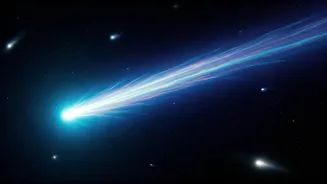
object caught in our Sun's gravity but a visitor just passing through. Designated 3I/ATLAS, it became only the third confirmed interstellar object (ISO) ever detected. Unlike its first predecessor, the bizarre and rocky 'Oumuamua, and more like its second, 2I/Borisov, this visitor was clearly a comet—an icy body with a glowing cloud of gas and dust called a coma. After a journey of millions or perhaps billions of years drifting through the void between stars, it swung through our neighbourhood, offering a fleeting but invaluable opportunity to study a piece of another solar system up close.
A Cosmic Fingerprint
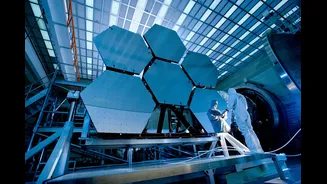
So how does a single comet sharpen our cosmic comparisons? By acting as a cosmic sample. Every object in our solar system formed from the same cloud of gas and dust, giving them a shared family chemistry. 3I/ATLAS, however, is a messenger with a foreign accent. Observations from powerful tools like the James Webb Space Telescope revealed a chemical fingerprint strikingly different from our local comets. For instance, it contains an exceptionally high amount of 'heavy water,' which uses a heavier version of hydrogen called deuterium. It also has unusual ratios of carbon isotopes. These details are like a cosmic birth certificate, telling scientists that 3I/ATLAS likely formed in an extremely cold and quiet environment, far from its parent star. This suggests its home system was much less turbulent and well-mixed than our own was during its formation, providing a direct point of comparison that highlights the potential diversity of planetary nurseries across the galaxy.
The Interstellar Trio
3I/ATLAS didn't arrive in a vacuum. It joins a very exclusive club. The first visitor, 1I/'Oumuamua (2017), was a baffling, rocky, cigar-shaped object that showed no cometary activity, leaving scientists debating whether it was an asteroid or something else entirely. Then came 2I/Borisov in 2019, which was a welcome sight: it looked and acted much like a typical comet, suggesting that perhaps 'Oumuamua was the odd one out. Now, 3I/ATLAS provides a crucial third data point. It's a comet like Borisov, but its unique chemical makeup makes it fundamentally different from both our own comets and from Borisov. Together, this trio begins to paint a picture not of uniformity, but of incredible variety. Each visitor adds a new brushstroke, showing that the building blocks of planets can be wildly different from one star system to the next.
A Flood of New Visitors
While three visitors have been revolutionary, the sample size is still tiny. Making broad conclusions about the galaxy from just three objects is like trying to understand all of humanity by meeting only three people. But that is about to change. A new generation of observatories, chief among them the Vera C. Rubin Observatory in Chile, is poised to transform the hunt for interstellar objects. Its massive camera and ability to scan the entire sky every few nights will likely turn the trickle of discoveries into a flood. Instead of one surprise discovery every couple of years, astronomers anticipate finding dozens of ISOs. This will allow them to move from studying individual curiosities to conducting a true population study, mapping the range of compositions and origins to build a comprehensive picture of how solar systems, including our own, fit into the grand scheme of the Milky Way.