
Peering Through the Cosmic Veil
For centuries, astronomers were faced with a frustrating paradox. The very places where stars are made—enormous, dense clouds of molecular gas and dust—are completely opaque to traditional telescopes. Trying to see a newborn star inside with visible light
is like trying to spot a candle flame in a thick fog. The dust particles, though tiny, effectively scatter and absorb the light, shrouding the dynamic processes of star birth in darkness. This left scientists with a picture of star formation that was largely theoretical, pieced together from indirect evidence. To truly witness the birth of a star, humanity needed a new way of seeing, one that could bypass the dusty veil and look directly into the heart of these cosmic nurseries.
The Power of Infrared Vision
The James Webb Space Telescope (JWST) is that new way of seeing. Launched as a collaboration between NASA, the European Space Agency (ESA), and the Canadian Space Agency (CSA), Webb is an observatory designed specifically to see the universe in infrared light. Unlike visible light, infrared light has a longer wavelength that allows it to slip past the tiny dust particles that make stellar nurseries look dark and impenetrable. It’s the astronomical equivalent of using an X-ray to see bones through skin. The telescope’s massive 6.5-meter primary mirror collects this faint infrared light, and its suite of advanced instruments, particularly the Near-Infrared Camera (NIRCam) and the Mid-Infrared Instrument (MIRI), translate it into the breathtaking images that have captivated the world. NIRCam is excellent at piercing through the thinner layers of dust, while MIRI can detect the glow of the warm dust itself, revealing the structure of the clouds.
A Gallery of Stellar Masterpieces
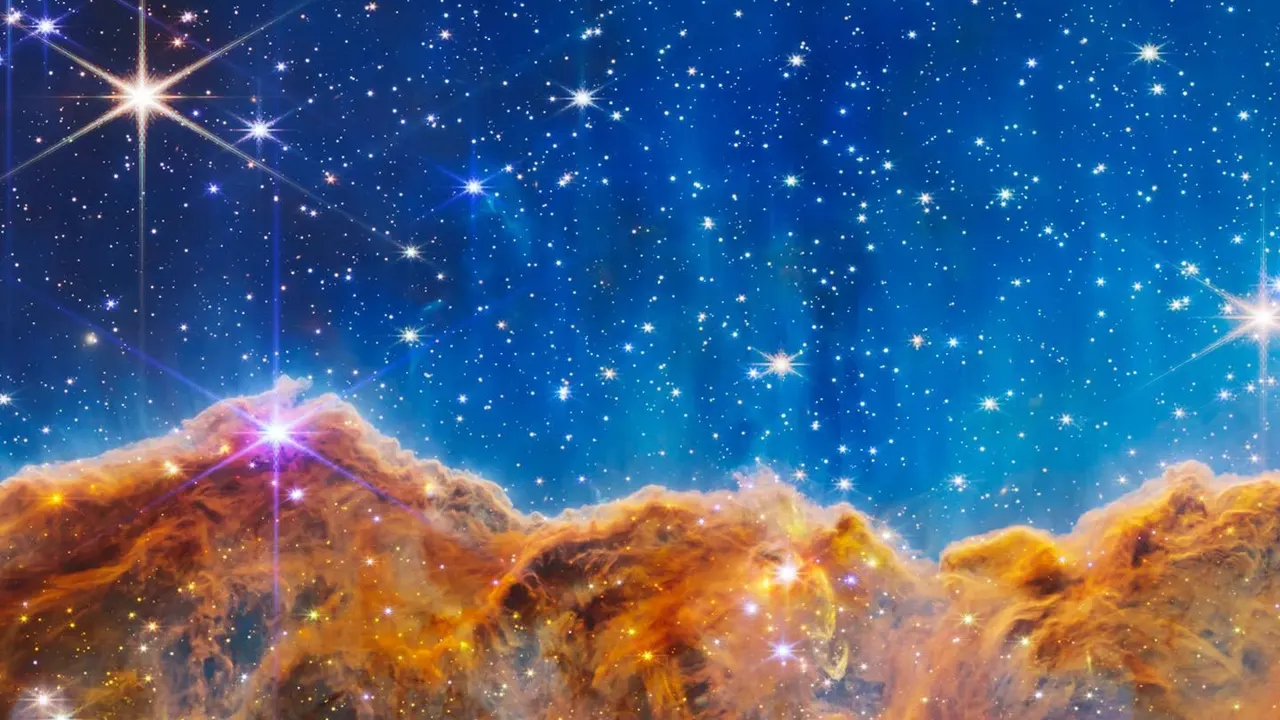
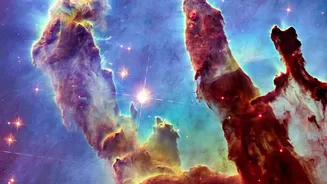
With this infrared superpower, Webb has opened up a gallery of previously hidden stellar objects. One of its most iconic early images was of the 'Cosmic Cliffs' in the Carina Nebula. What appeared to Hubble as a nebulous wall of gas was revealed by Webb to be a glittering landscape of star birth, with hundreds of previously unseen stars emerging from their dusty cocoons. In these images, we can clearly see the tell-tale signs of young stars: bright red dots indicating protostars still gathering mass, and powerful jets of gas shooting out from their poles. These jets, sometimes extending for light-years, are a crucial part of star formation, clearing away surrounding material as the star grows. Webb has also provided stunning new views of the famous Pillars of Creation, peering inside the dusty columns to reveal the fiery red glow of newly formed stars.
From Pictures to Physics
These images are more than just pretty pictures; they are treasure troves of scientific data. By studying them, astronomers can now witness the earliest and most elusive stages of star formation in unprecedented detail. For the first time, scientists can directly observe how protostars pull in gas and dust from a surrounding disk, a process known as accretion. They can analyze the chemical composition of the clouds, identifying the ices and molecules that will eventually form not just stars, but the planets that orbit them. For instance, recent Webb observations have helped show how massive stars form, supporting the theory that they grow from stable, rotating disks of material, much like their smaller cousins. By comparing images taken years apart, as with archival Hubble data, scientists can even track the movement and speed of these stellar jets, watching the process unfold over time.