

Whispers from the Void
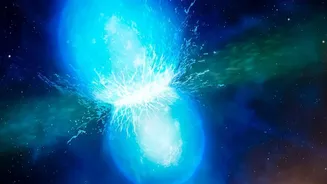
Imagine dropping a stone into a perfectly still pond. The ripples that spread out tell you something happened, even if you didn't see the splash. Gravitational waves are like those ripples, but in the fabric of spacetime itself. Predicted by Einstein,
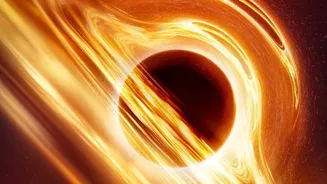
these waves are generated by the most violent events in the cosmos, such as the collision of two black holes. For decades they were purely theoretical, but since 2015, observatories like LIGO, Virgo, and KAGRA have been able to detect these faint whispers. By analysing the precise shape of these waves, scientists can deduce incredible details about their source: the masses of the colliding objects, how fast they were spinning, and how far away the cataclysm occurred.
The Mystery of Galaxy Seeds
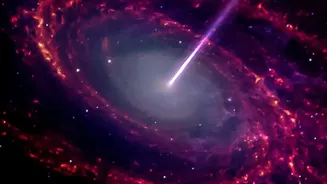
Every massive galaxy, including our own Milky Way, is thought to have a supermassive black hole at its center. But this poses a cosmic chicken-and-egg problem. Which came first: the galaxy or the black hole? For a galaxy to form, gravity needs an initial 'lump' to start pulling matter together. Without a starting point, the faint gas of the early universe would have been too spread out to collapse into the structures we see today. Scientists call these initial lumps 'galaxy seeds'. The trouble is, we don't know for sure what they were. One leading theory suggests they were giant clouds of gas that collapsed, but another, more exotic idea has been gaining traction: primordial black holes.
Hunting for Primordial Black Holes
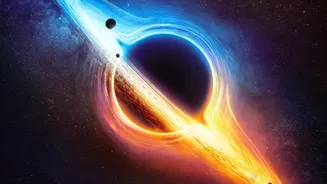
Unlike the black holes we're familiar with, which form from the collapse of giant stars, primordial black holes (PBHs) are hypothetical objects that may have formed in the dense chaos of the first second after the Big Bang. Because they weren't made from stars, they could come in a much wider range of sizes, including some that are smaller than our sun—a mass that is impossible for a standard black hole. If these PBHs existed, they would have been scattered throughout the early universe, acting as the perfect gravitational seeds around which matter could coalesce to form the first galaxies. They are also a leading candidate for the elusive substance known as dark matter.
Connecting Collisions to Creation
This is where gravitational waves come in. If the universe was once filled with a population of primordial black holes, they would have been colliding and merging from the very beginning. By detecting the gravitational waves from these ancient mergers, we are essentially taking a census of the black hole population throughout cosmic history. Scientists are looking for specific tell-tale signs. For instance, finding a black hole with a mass less than the sun would be a smoking gun, as stellar evolution can't produce them. In fact, a potential signal fitting this description was reported in early 2026, causing a surge of excitement that LIGO may have found the first direct evidence of a PBH.
A New Era of Cosmology
By comparing the rate and mass distribution of detected mergers with theoretical models, scientists can test the idea that PBHs acted as galaxy seeds. If the observed data aligns with predictions for a universe with PBHs, it would fundamentally change our understanding of cosmology. Recent detections have already challenged our models, revealing black holes in a 'mass gap' where they were thought to be exceptionally rare and showing evidence of repeated or 'hierarchical' mergers where black holes grow by cannibalising each other. Each new detection adds another pixel to the picture of our cosmic origins, turning gravitational wave observatories into powerful time machines that probe not just the nature of black holes, but the evolution of the entire universe.