




The Hunt for Atmospheric Clues
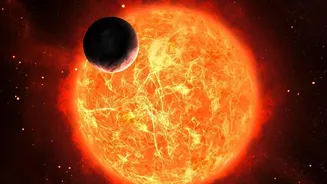
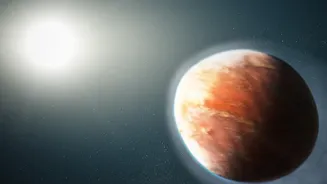
To find water, astronomers first need to find a planet passing in front of its star, an event called a 'transit'. As the exoplanet makes this pass, a tiny fraction of the starlight filters through the planet's atmosphere. For scientists, that filtered
light is a treasure trove of information. The method of analysing it is called transmission spectroscopy. Each chemical element and compound in the atmosphere absorbs light at very specific colours or wavelengths. By looking at which colours are missing from the starlight after it has passed through the atmosphere, astronomers can identify the molecules present, creating a chemical fingerprint of that distant world.
Webb's Infrared Advantage
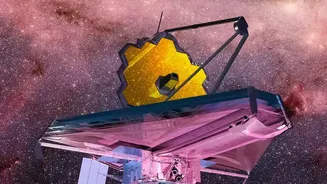
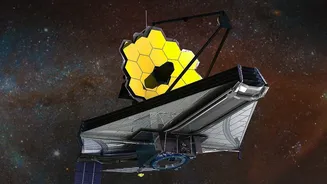
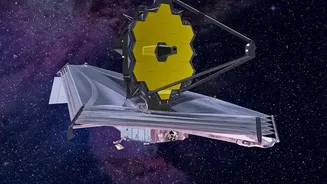
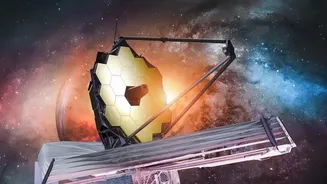
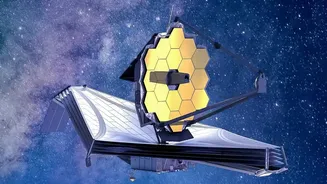
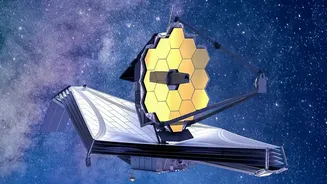
This is where the James Webb Space Telescope's power comes into play. Unlike telescopes that see primarily visible light, like the Hubble, Webb is optimised to see in the infrared spectrum. This is crucial because many of the most interesting molecules, including water, methane, and carbon dioxide, have their strongest and most distinct absorption signatures in infrared light. Before JWST, many attempts to study exoplanet atmospheres resulted in frustratingly flat or featureless data. But Webb's immense mirror and extreme sensitivity to infrared wavelengths allow it to capture these subtle chemical fingerprints with unprecedented detail, turning previously blank canvases into rich portraits of alien skies.
A Symphony of Instruments
JWST uses a suite of highly advanced instruments to perform this cosmic detective work. The two main tools for this job are the Near-Infrared Spectrograph (NIRSpec) and the Mid-Infrared Instrument (MIRI). Together, they cover a massive range of infrared wavelengths from 0.6 to 28.5 micrometres. NIRSpec is excellent for capturing a broad spectrum quickly, while MIRI can provide exquisite detail in the mid-infrared range. Other instruments like the Near-Infrared Imager and Slitless Spectrograph (NIRISS) also play a key role, particularly for brighter targets. By combining data from these instruments, scientists get the most complete and detailed spectrum of an exoplanet's atmosphere possible, allowing them to confirm the presence of molecules with high confidence.
The Unmistakable Signature of Water
When astronomers analyse the data from a planet like WASP-96 b or K2-18 b, they are looking for a specific pattern in the spectrum. In the case of water (H2O), this appears as a series of peaks and troughs at very specific infrared wavelengths. The strength of this signal—how much light the water molecules absorbed—tells scientists not just that water is present, but can also give clues about its abundance. For the exoplanet WASP-96 b, located 1,150 light-years away, JWST provided an unambiguous signature of water, along with evidence of clouds and haze that previous observations couldn't detect. This marked a giant leap forward from earlier detections by Hubble, showcasing Webb's revolutionary power.
Challenges and Future Discoveries
The process isn't always straightforward. When studying rocky planets around cool red dwarf stars, astronomers must be careful. Water vapour can also exist in cool spots on the star itself, creating a signal that could be mistaken for a planetary atmosphere. For the rocky exoplanet GJ 486 b, scientists detected a water signal but couldn't definitively tell if it came from the planet or its star. Disentangling these signals is a major challenge that requires careful modelling and often observations with multiple instruments. Despite these hurdles, each new detection adds a crucial piece to the puzzle. By studying the composition of these distant worlds, from hot gas giants to potentially water-covered 'Hycean' planets, JWST is not just finding water; it’s helping us understand how planets form and paving the way in the search for habitable worlds.