



A Groundbreaking, Yet Puzzling, Signal
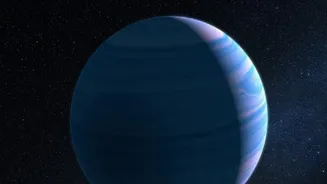
Scientists using the powerful JWST have detected signs of water vapour around a rocky exoplanet just 26 light-years away. The planet, known as GJ 486 b, is a super-Earth, about 30% larger and three times more massive than our own world. While water has
been found on gaseous giants before, finding it associated with a rocky planet is a major milestone. However, the discovery comes with a significant puzzle. The science team cautions that the signal could be coming from the planet itself, which would suggest it has an atmosphere, or it could be an illusion created by water vapour in cool spots on its host star.
How Webb Gazes Into Alien Atmospheres
To make such a delicate detection, astronomers rely on a technique called transmission spectroscopy. When an exoplanet passes in front of its star from our point of view, a tiny fraction of the starlight filters through the planet's atmosphere. Different gas molecules absorb light at specific wavelengths, leaving a unique chemical fingerprint in the light that reaches the telescope. By analysing this fingerprint, scientists can decode the composition of the planet's atmosphere. For GJ 486 b, the Webb telescope's Near-Infrared Spectrograph (NIRSpec) observed the planet for two transits, each lasting about an hour, to capture the faint signal.
Planet's Steam or a Star's Deception?
The central mystery surrounding GJ 486 b is the source of the water. The planet orbits its red dwarf star so closely that its surface sizzles at around 430 degrees Celsius, far too hot for liquid water. If it has an atmosphere, it would likely be a steamy one constantly replenished by volcanic activity. The alternative, equally plausible theory is that the water signal comes from the star itself. Red dwarf stars are much cooler than our sun, and water vapour can exist in dark, cool patches on their surface called starspots. This stellar 'contamination' could create a signal that perfectly mimics a planetary atmosphere, and more observations are needed to tell the two scenarios apart.
More Than One Rocky World in Webb's Sights
The investigation isn't limited to a single world. The JWST has also been examining 55 Cancri e, another super-Earth about 41 light-years away. This planet is even more extreme, a 'lava world' where surface temperatures are hot enough to melt rock. Here, Webb has found the best evidence to date for an atmosphere around a rocky exoplanet, one that is likely rich in carbon monoxide and carbon dioxide, and possibly being fed by gases bubbling out of its magma ocean. While not water vapour, this discovery on 55 Cancri e reinforces that Webb is capable of characterising the thin atmospheres of rocky worlds, a feat previously beyond our reach.
A Crucial Step in the Search for Life
Finding water, in any form, is a critical step in the search for life beyond Earth. While hot planets like GJ 486 b and 55 Cancri e are not habitable, the techniques being pioneered on them are revolutionary. They prove that the JWST can detect and analyse the atmospheres of small, rocky planets. The ultimate goal is to turn this powerful tool toward Earth-like planets that orbit within their star's 'habitable zone'—the temperate region where liquid water could potentially exist on a planet's surface. Discoveries of water on planets like K2-18b, made with the Hubble telescope, have already set the stage for Webb to conduct even more detailed follow-up studies.