



Meet the 'Sparkler' Galaxy
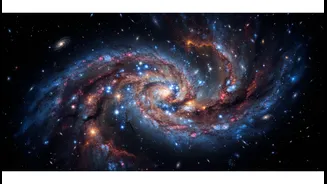
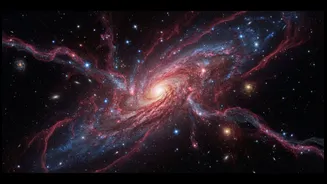
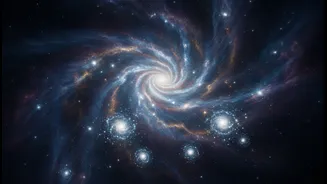
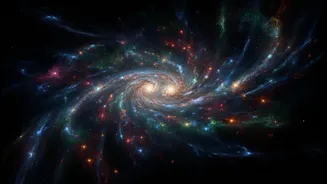
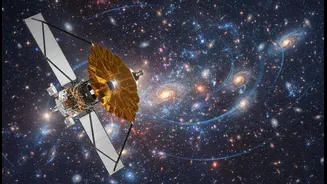
Deep in one of the first images from the James Webb Space Telescope (JWST), astronomers spotted a distant galaxy, located some 9 billion light-years away. It appeared with a series of small, sparkling dots around it, earning it the nickname the 'Sparkler'
galaxy. These sparkles are incredibly ancient, dense groups of millions of stars known as globular clusters. What makes this possible is a cosmic phenomenon called gravitational lensing. A massive galaxy cluster in the foreground acts like a giant magnifying glass, bending and amplifying the light from the Sparkler, which is much farther behind it. This natural telescope allowed the JWST to see the Sparkler and its surrounding clusters in unprecedented detail, something even the Hubble Space Telescope couldn't resolve.
Decoding the Light Spectrum
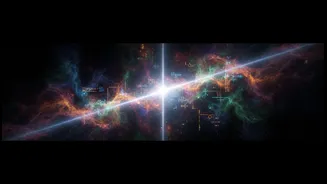
To understand the universe's chemical history, scientists practice spectroscopy—the science of analyzing light by splitting it into its different colors or wavelengths, much like a prism makes a rainbow. When light from a star or galaxy travels through space, it passes through the interstellar medium (ISM)—the vast, diffuse clouds of gas and dust that exist between stars. Atoms and molecules in this gas absorb light at very specific wavelengths, leaving behind dark lines in the spectrum. Each element, like hydrogen, helium, or oxygen, has a unique 'barcode' of absorption lines. By reading this barcode in the light from the Sparkler, astronomers can determine exactly what elements were present in the gas clouds of the early universe.
A Blueprint of the Early Universe
The analysis of the Sparkler’s light revealed something remarkable. The globular clusters surrounding it are ancient, having formed when the universe was only about four and a half billion years old. Their light tells us about the chemical conditions shortly after the Big Bang. In the beginning, the universe contained only the lightest elements: hydrogen and helium. Heavier elements, which astronomers call 'metals,' were forged inside the first generations of massive stars and then blasted into space when those stars exploded. The light from the Sparkler’s clusters showed they were already chemically enriched, meaning several generations of stars had lived and died within them, seeding the interstellar medium with these heavier elements. This provides a direct look at the 'enrichment' process that made future planets and life possible.
Why This Discovery Matters
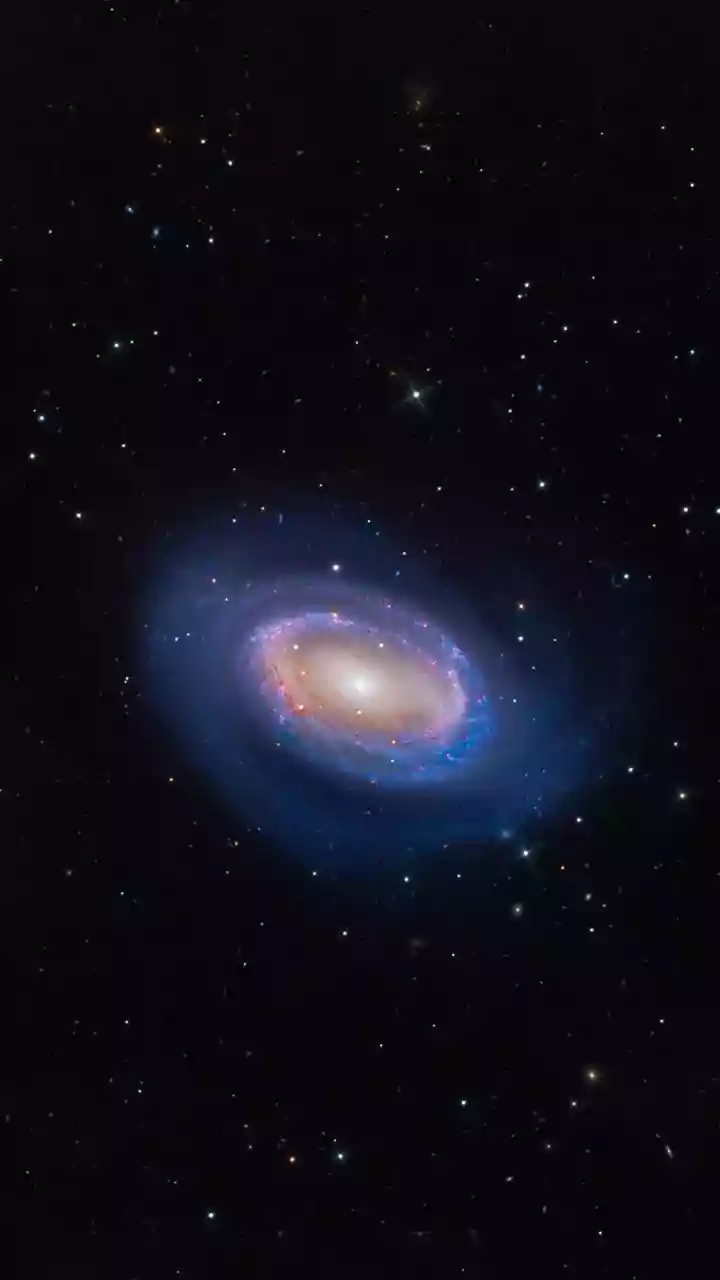
Studying the Sparkler and its clusters is like finding a fossil of our own Milky Way galaxy in its infancy. The Sparkler itself is small, only about 3% of the Milky Way's current mass, but it is expected to grow into a galaxy of similar size. By observing it, astronomers are witnessing the assembly process of a large galaxy, seeing it accrete smaller satellite galaxies and star clusters. Before the JWST, it was nearly impossible to study the chemical makeup of such distant, faint objects. This discovery opens a new window into understanding how the first stars formed, how they enriched the cosmos with the chemical building blocks of life, and how massive galaxies like our own came to be.