

The Ultimate Lunar Resource
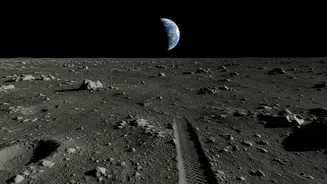
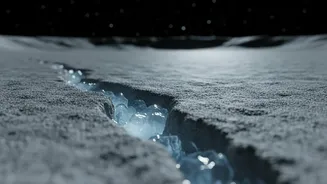
Finding water on the Moon is a game-changer. For decades, scientists believed the Moon was completely dry. Discovering water ice, particularly in the permanently shadowed regions (PSRs) near the poles, has ignited a new space race. This isn't just about
quenching an astronaut's thirst. Water (H₂O) can be split into hydrogen and oxygen, providing breathable air and, crucially, rocket propellant. The ability to generate fuel on the Moon would dramatically reduce the cost and complexity of deep space missions, making long-term lunar bases and even trips to Mars more feasible. Essentially, lunar water is the ultimate local resource, the key to unlocking humanity's sustainable future beyond Earth.
Reading Clues in the Dust
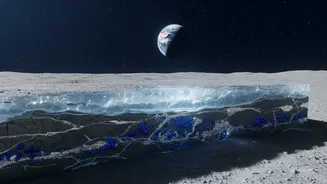
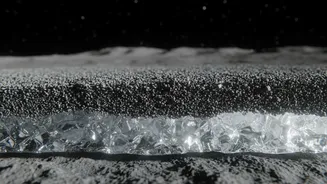
So, how do you find something that's buried and invisible from the surface? You study the soil it's mixed with. The Moon is covered in a layer of fine dust and broken rock called regolith. Scientists have realised that the physical and electrical properties of this regolith change in the presence of ice. One key property is the dielectric constant, which describes how a material responds to an electric field. Dry regolith, frozen water ice, and the vacuum of space all have vastly different dielectric values. By sending radar signals into the ground and analysing the echoes that bounce back, scientists can infer the composition of the subsurface. An unusual signal can indicate a boundary between dry soil and an ice-rich layer. Temperature is another critical clue; instruments that measure how heat travels through the top layer of soil can also point to the presence of ice.
ISRO’s Advanced Tools for the Job
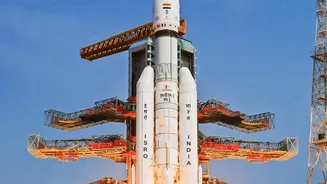
This is where the Indian Space Research Organisation (ISRO) plays a pivotal role. The orbiter from the Chandrayaan-2 mission, which has been circling the Moon since 2019, is equipped with a powerful instrument called the Dual-Frequency Synthetic Aperture Radar (DFSAR). It's the first of its kind to study the Moon using two different radar frequencies (L-band and S-band), allowing it to probe the lunar surface and subsurface at different depths. By analysing how these radar signals are reflected, scientists can create maps that suggest where subsurface ice might be concentrated. In May 2026, scientists using this very data announced strong evidence of subsurface ice in craters near the Moon's south pole. This followed earlier discoveries from India's Chandrayaan-1 mission, which carried a NASA instrument that provided the first definitive proof of water on the Moon.
From Data to Discovery
The raw data from an instrument like DFSAR isn't a simple picture of ice. It’s a complex stream of signals that requires careful analysis. Scientists have developed refined methods to distinguish the signature of ice from that of rough, rocky terrain. For instance, they look at a combination of radar measurements, such as the Circular Polarisation Ratio (CPR). Ice tends to reflect radar waves in a very specific way that looks different from a dry, rocky surface. When these unique signals come from permanently shadowed craters—some of the coldest places in the solar system—the confidence that they are detecting ice increases significantly. The data from Chandrayaan-2's orbiter has allowed researchers at institutions like the Physical Research Laboratory to pinpoint specific craters, some as small as 1.1 km wide, that show compelling evidence of buried ice.
The Next Frontier: Ground Truth
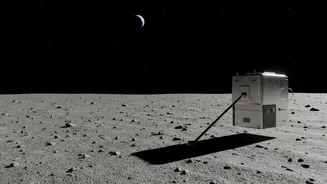
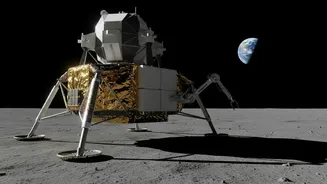
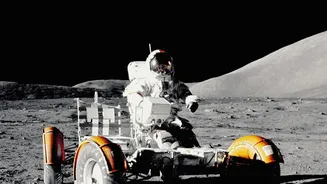
While orbital data from ISRO's instruments is incredibly valuable for creating potential maps of lunar water, the next step is verification on the ground. This is known as seeking 'ground truth'. Future lunar missions, including the joint India-Japan LUPEX rover, are being designed to land in these promising polar regions. These missions will carry instruments, including drills and spectrometers, to directly sample the regolith and confirm the presence, quantity, and state of the water ice. Data from ISRO's orbiters is therefore not just an academic exercise; it provides the crucial reconnaissance needed to select the most promising landing sites for these future missions, saving time and ensuring the best possible chance of success in the ongoing quest for lunar resources.