


Seeing the Invisible Light
To understand the early universe, you have to look for light that has been traveling for over 13 billion years. As the universe expands, this light gets stretched into longer, redder wavelengths, shifting from visible light into the infrared spectrum.
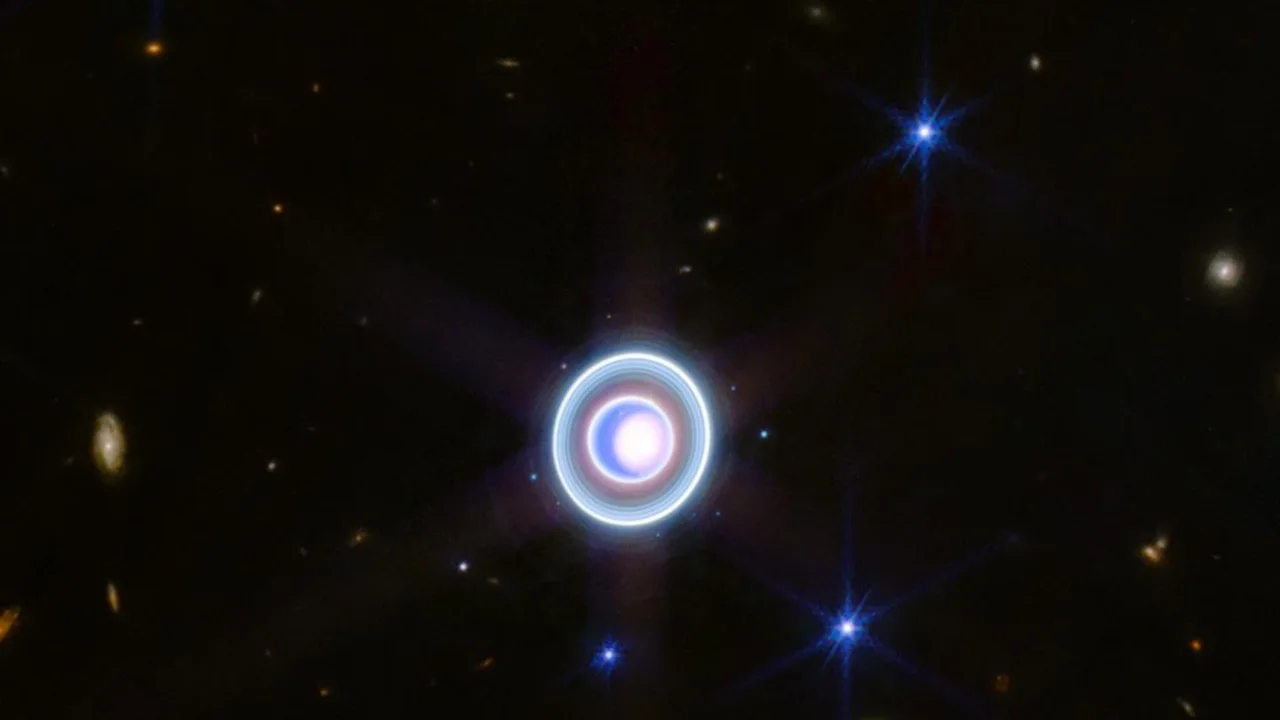
This is where the James Webb Space Telescope (JWST) excels. Unlike its predecessor, Hubble, which primarily sees in visible and ultraviolet light, Webb is optimized to detect infrared light. This allows it to peer through the cosmic dust clouds that obscure the view for other telescopes and capture the faint glow of the very first galaxies. Its massive 6.5-meter primary mirror collects more of this ancient light than ever before, providing a window into a time when the universe was just a few hundred million years old.
Decoding Cosmic Fingerprints
Stunning images are only half the story. Webb's true power lies in its suite of highly sensitive instruments designed for spectroscopy. Think of spectroscopy as a way to break down light into its constituent colors, like a prism creating a rainbow. Instruments like the Near-Infrared Spectrograph (NIRSpec) and the Mid-Infrared Instrument (MIRI) analyze these cosmic rainbows. Every chemical element and molecule absorbs and emits light at specific wavelengths, creating a unique “fingerprint” in the light's spectrum. By reading these fingerprints, astronomers can precisely determine the chemical composition of distant galaxies. This is how Webb moves beyond just seeing that a galaxy exists to understanding what it's made of—identifying elements like carbon, oxygen, and neon in the primordial cosmos.
Finding Complexity Where None Was Expected
Before Webb, scientists expected the earliest galaxies to be simple, made almost exclusively of the lightest elements like hydrogen and helium forged in the Big Bang. Heavier elements, which astronomers call “metals,” were thought to have been created much later in the cores of stars. Webb’s discoveries have turned this assumption on its head. Astronomers using the telescope have found significant amounts of carbon in a galaxy just 350 million years after the Big Bang. Even more surprisingly, Webb has detected complex organic molecules, specifically polycyclic aromatic hydrocarbons (PAHs), in a galaxy more than 12 billion light-years away. On Earth, PAHs are found in soot and smoke, but in space, their presence indicates surprisingly rich and rapid chemical evolution was happening when the universe was less than 1.5 billion years old.
Rewriting the First Cosmic Chapters
These discoveries of early, complex chemistry are forcing scientists to rethink their models of how the first stars and galaxies formed. The presence of elements like carbon so early suggests that the first generations of stars lived and died much faster than previously thought, seeding the universe with heavier elements that spurred the creation of more complex structures. Webb is finding that early galaxies were not just chemically diverse but also surprisingly massive and structured. For instance, the telescope identified an active supermassive black hole in a galaxy called CEERS 1019, which existed just 570 million years after the Big Bang. Such discoveries challenge theories about how quickly black holes can grow and how they influence the development of their host galaxies.