







Before You Turn the Key: A Pre-Drive Check
Your first line of defense against rainy conditions is a well-prepared vehicle. Before you head out, take a few minutes for some crucial checks. Inspect your tyres to ensure they have adequate tread depth; worn tyres struggle to grip wet roads and increase
the risk of hydroplaning. [9, 25] The legal minimum tread depth is 1.6mm, but more is always better for wet conditions. [22] Also, check that your tyres are inflated to the manufacturer's recommended pressure. [5, 7, 9] Next, test your windshield wipers. If they leave streaks or make noise, it's time to replace them. [9, 25] Finally, ensure all your lights are working—headlights, taillights, brake lights, and turn signals. [9, 23] Clean lights are crucial for visibility, helping you see the road and helping others see you. [22]
The Golden Rule: Slow Down and Increase Distance
The single most important adjustment to make when driving in the rain is to reduce your speed. [10, 12] Wet roads dramatically increase your vehicle's stopping distance. At speeds as low as 55-60 km/h, your tyres can start to lose contact with the road surface. [10] Slowing down gives your tyres more time to channel water away and maintain grip. It also provides you with more time to react to unexpected hazards. Just as crucial is increasing the following distance between your vehicle and the one in front of you. [10, 12] Aim for at least a three- to four-second gap, which gives you a larger safety buffer if you need to brake suddenly. [4]
Mastering Visibility in a Downpour
Seeing and being seen are paramount. Even during the day, turn on your headlights to increase your visibility to other drivers. [5, 10, 15] Use your air conditioner and defogger to keep your windows from fogging up on the inside. [18, 21] If visibility becomes so poor that you feel unsafe, don't hesitate to pull over. [5] Find a safe spot, like a designated rest area or a shoulder far from moving traffic, and wait for the worst of the rain to pass. It is also wise to turn off cruise control. [2, 10] You need to have full manual control of your vehicle to react quickly to changing road conditions. [10]
What to Do When You Hydroplane
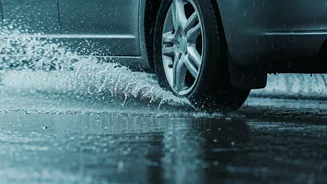
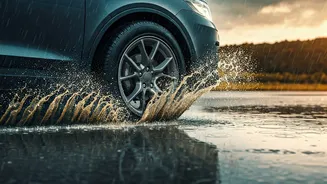
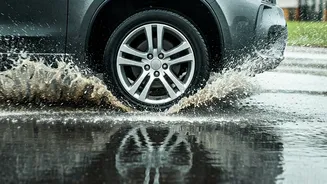
Hydroplaning happens when a layer of water builds up between your tyres and the road, causing a loss of traction and control. [14] It can feel like the car is floating. If this happens, it's critical to remain calm and not panic. [2, 4, 7] Do not slam on the brakes, as this can make the skid worse. [1, 2, 7] Instead, ease your foot off the accelerator and keep the steering wheel pointed in the direction you want to go. [2, 14] Avoid making any sudden turns. As the vehicle slows, the tyres should regain contact with the road, and you will feel control return. [2, 14]
Navigating Puddles and Flooded Roads
Standing water can be far more dangerous than it appears. It's often impossible to tell how deep a puddle is or what hazards might be hidden beneath the surface, such as potholes or debris. [5, 6, 13] As little as six inches of water can be enough to stall many passenger cars, and just a foot of moving water can sweep a vehicle away. [3, 8, 19] The safest course of action is always to avoid driving through flooded areas. [3, 8, 13] If you encounter a waterlogged road, turn around and find an alternate route. [8] It’s not worth risking severe damage to your car's engine and electrical systems, or worse, your own safety. [3, 19]