






More Than Just Another Eye in the Sky
When we think of climate science, we often picture satellites capturing sweeping images of Earth. While we have many 'eyes' in orbit, a fundamental challenge has been ensuring they all see the world the same way. Over decades, dozens of satellites from
various nations and agencies have collected climate data. Each has its own technology, its sensors degrade at different rates, and they are eventually replaced by newer models. This creates a huge problem for scientists: how to stitch together this patchwork of information into a single, reliable, long-term record. Without a consistent benchmark, detecting subtle, long-term climate trends can be like trying to hear a whisper in a noisy room. This is where NASA's Climate Absolute Radiance and Refractivity Observatory (CLARREO) Pathfinder comes in, not as just another sensor, but as the master tuning fork for all the others.
The Problem: An Orchestra Out of Tune
Imagine trying to judge the performance of an orchestra over 40 years by listening to separate recordings made with different microphones in different halls. Some microphones might lose sensitivity to high notes over time, while others might develop a buzz. This is the challenge climate scientists face. They rely on observing changes in Earth's albedo—the amount of solar radiation reflected back into space. Small changes in this energy balance have enormous implications for global temperatures and weather patterns. However, if one satellite's sensor degrades and reports a slightly dimmer reflection, it could be misinterpreted as a real change on Earth. This uncertainty is a major hurdle, as decisions on climate policy worth trillions of dollars depend on having the best possible evidence. Critics can leverage this data ambiguity to question the validity of climate models. The need for a universally accepted, highly accurate reference standard has never been more critical.
The Solution: A 'Gold Standard' in Orbit
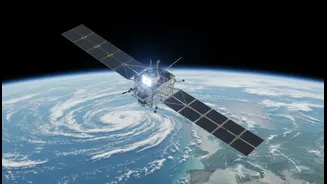
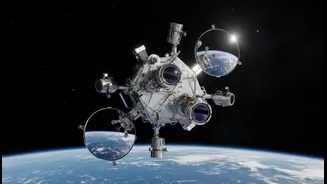
The CLARREO Pathfinder is essentially a metrology lab in space. Hosted on the International Space Station (ISS), its primary instrument, the Hyperspectral Imager for Climate Science (HySICS), is designed to measure reflected sunlight with unprecedented accuracy—five to ten times better than existing sensors. Unlike other instruments, it is built to be calibrated on-orbit. By pointing its sensor directly at a known, stable source—the Sun—it can constantly check and correct its own measurements, ensuring its accuracy remains traceable to international scientific standards (SI-traceable). This makes it the 'gold standard' reference. As it orbits, it crosses paths with other Earth-observation satellites. During these encounters, it takes a simultaneous measurement of the same spot on Earth. By comparing its own hyper-accurate reading with that of the other satellite, it effectively calibrates the other instrument, bringing the entire global fleet of sensors into harmony.
What Pathfinder Has Proven
The CLARREO Pathfinder mission, which began in 2016, is a demonstrator for the full CLARREO mission concept. Its time on the ISS is intended to prove that this technology and calibration method works in the harsh environment of space. By successfully measuring reflected solar radiation and demonstrating its ability to serve as a reference for other sensors like CERES and VIIRS, it has achieved its primary goals. The data it gathers not only improves the reliability of other satellite measurements but also enhances the use of the Moon as another stable calibration target for the entire satellite community. The success of this pathfinder mission paves the way for a new era of climate science where data is not only abundant but also incredibly trustworthy, allowing scientists to detect climate trends decades sooner than previously possible.
Why Data Reliability Matters for India
For a nation as vulnerable to climate change as India, this technological leap is profoundly important. The integrity of climate models directly impacts national policy on everything from water resource management and agricultural planning to coastal infrastructure and public health. More accurate data on Earth's energy balance leads to better predictions about monsoon variability, the intensity of heatwaves, and the rate of sea-level rise. When policymakers can act on climate models with higher confidence, they can make more effective, targeted investments in adaptation strategies. By removing ambiguity from the data, technologies like CLARREO Pathfinder strengthen the scientific foundation upon which India can build a more resilient future, ensuring that decisions are based on the most reliable evidence available.