

Look up on a clear night, and you see points of light against an endless backdrop of black. But if the universe is filled with trillions of stars, shouldn't the entire sky blaze with light? This is a famous cosmic puzzle.
The Old Puzzle of a Bright Night
For centuries, astronomers and
thinkers were stumped by this question, which became known as Olbers' Paradox. The logic seemed simple: if the universe was infinite, static, and filled with stars, then no matter where you looked, your line of sight should eventually end on the surface of a star. Distant stars would appear fainter, but there would be more of them in each successive layer of space. In theory, the sheer number of stars should compensate for their distance, creating a sky that was uniformly bright. Some suggested that cosmic dust might block the light, but that explanation didn't hold up. Over an infinite amount of time, that dust would absorb so much energy that it would heat up and start glowing itself.
The Universe Had a Beginning
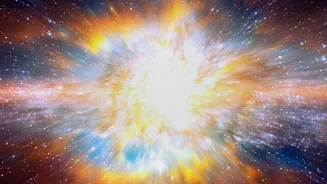
The first major clue to solving the paradox came with a revolutionary discovery in the 20th century: the universe is not infinitely old. Modern cosmology shows that our universe began approximately 13.8 billion years ago with the Big Bang. Since light travels at a finite speed, we can only see light from stars and galaxies that has had enough time to reach us within those 13.8 billion years. Light from stars beyond a certain 'cosmic horizon' simply hasn't arrived yet. The sky is dark in certain spots because, in those directions, the stars are so far away that their light is still on its journey to Earth.
An Expanding Cosmos
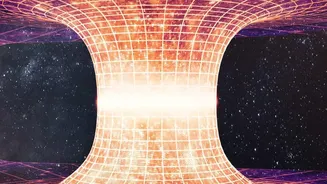
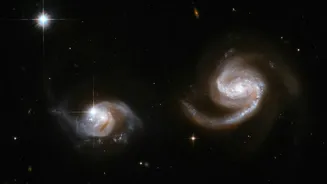
The second piece of the puzzle is just as important: the universe is not static. In the 1920s, astronomer Edwin Hubble provided observational proof that the universe is expanding. He observed that distant galaxies are moving away from us, and the farther away they are, the faster they are receding. This isn't like objects flying through a fixed space; rather, the fabric of space itself is stretching. This universal expansion has a profound effect on the light traveling through it.
Stretching Light Out of Sight
As light from a distant galaxy travels across billions of light-years of expanding space, its wavelength gets stretched. This phenomenon is known as 'cosmological redshift'. The light is shifted towards the longer-wavelength, redder end of the spectrum. For the most distant galaxies moving away from us at incredible speeds, their light can be stretched so much that it moves beyond the visible spectrum into infrared, microwaves, or radio waves. Our eyes cannot detect these wavelengths, so even though the energy is still traveling through space, it becomes invisible to us. The universe, in a sense, is glowing in colours we cannot see.
The Darkness Is the Answer
When you put these ideas together, the darkness of the night sky starts to make sense. It’s not dark because there’s a lack of stars. It’s dark because of two fundamental properties of our universe. First, the universe has a finite age, so the light from the most distant stars has not yet reached us. Second, the expansion of the universe stretches the light from faraway galaxies, shifting it out of the visible range and reducing its energy. Far from being an empty void, the darkness between the stars is a direct consequence of the universe having a dynamic history that began with the Big Bang.