






The AI 'Black Box' Problem
For years, the inner workings of large AI models like Claude and its competitors have been a mystery. Researchers can see the data that goes in and the answer that comes out, but the complex web of calculations in between is so dense it's effectively
a 'black box.' This isn't just a curious academic puzzle; it's a massive barrier to trust and safety. If we can't understand why an AI makes a particular decision, how can we be sure it isn't operating on hidden biases, or that it won't behave in unexpected and dangerous ways? The field dedicated to solving this is called interpretability, and its goal is to make AI's reasoning legible to its human creators.
Borrowing a Theory from the Human Brain
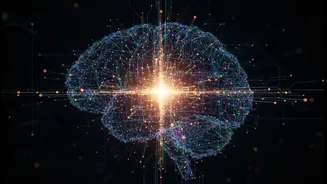
To map the alien mind of an AI, Anthropic's researchers turned to a theory about our own. Global Workspace Theory (GWT), proposed in the 1980s, suggests human consciousness works like a theater's stage. Our brain has countless specialised processes working in parallel unconsciously in the 'audience.' When a piece of information becomes important enough to require focused attention, it's broadcast from the 'stage' to the entire system, becoming part of our conscious experience. This shared space allows different parts of the brain to integrate information and work together on complex tasks.
Finding a Workspace Inside Claude
In a recent paper, Anthropic's interpretability team announced they had found something functionally similar to this global workspace inside their Claude models. Using techniques like 'dictionary learning,' which breaks down complex AI activity into understandable concepts or 'features,' they identified a specific internal area where high-level concepts converge. The researchers found that concepts the model could talk about—like the 'Golden Gate Bridge'—were represented in this central hub, which they dubbed 'J-space.' This suggests the model has a privileged set of internal representations it uses for flexible reasoning, much like the information broadcast on the 'stage' of the GWT.
What This Breakthrough Actually Means
This discovery is a significant step forward for interpretability. Instead of trying to decipher the meaning of millions of individual neurons, researchers may be able to focus on this central workspace to get a clearer picture of what the AI is 'thinking.' It provides a handle, a more tractable way to observe and maybe even influence the model's reasoning process. For example, Anthropic found that training the model to articulate its ethical principles when interrupted actually improved its behaviour even when it wasn't interrupted, suggesting a link between the workspace and the model's actions. It's the difference between listening to a million private conversations and tuning into a public announcement system.
What the Research Still Cannot Prove
Despite the exciting parallel, Anthropic is clear this does not prove AI is conscious. The research reveals a functional similarity, not a biological one. More importantly, it doesn't solve the core safety problems yet. A model could still have deceptive intentions that are formulated outside this observable workspace. The map is not the territory; seeing a concept like 'honesty' appear in the J-space doesn't guarantee the model's final output will be honest. Furthermore, the researchers themselves admit their primary tool, the 'Jacobian lens,' is an 'imperfect tool' that only captures the workspace structure approximately and incompletely.
The Lingering Challenges of Scale and Complexity
A major unknown is whether these findings will hold up as models become exponentially more powerful. This research was conducted on specific versions of Claude. As AI systems scale, their internal complexity might once again outpace our ability to interpret them. The engineering challenges are immense; Anthropic notes that simply shuffling the massive datasets required for this research is a major hurdle. There's also no guarantee that this 'workspace' structure is a universal feature of all AI models or that it won't change dramatically in future architectures. This early success is a promising start, but the work of mapping a small part of a single model highlights the vast, uncharted territory that remains.