



A Personal Spaceship, Not Just Clothes
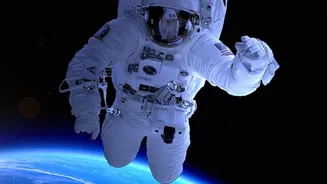
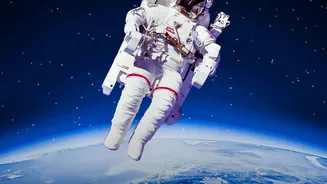
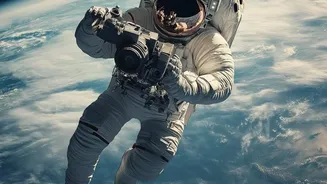
A modern spacesuit, like NASA's Extravehicular Mobility Unit (EMU), is not merely a set of garments but a self-contained life support system. It provides oxygen, maintains pressure, manages temperature, and, crucially, serves as a shield against the relentless
hazards of open space. Weighing over 145 kg on Earth, this complex machine is a testament to human ingenuity, designed to create a tiny bubble of Earth's environment around an astronaut. Its primary job during a spacewalk, or Extravehicular Activity (EVA), is to protect against two invisible but potentially lethal threats: micrometeoroids and solar radiation.
The Menace of Micrometeoroids
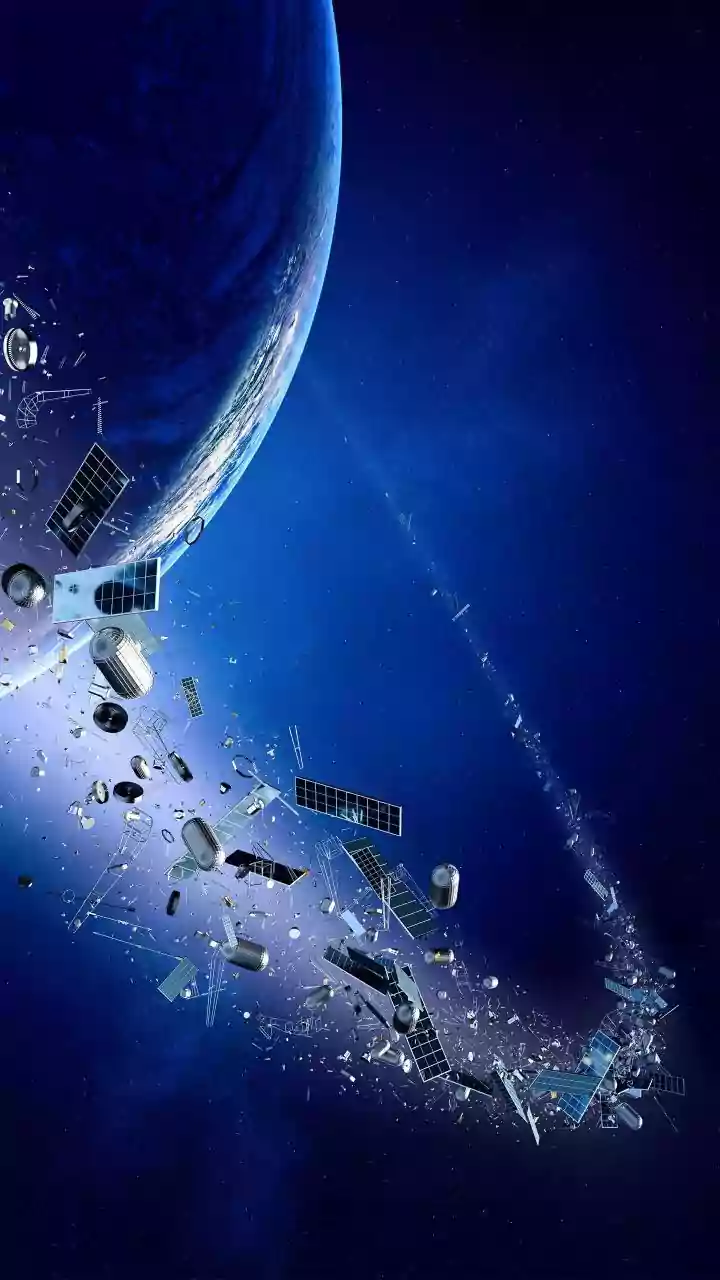
Space may look empty, but it's filled with tiny particles of rock, metal, and debris, many no larger than a grain of sand. These are micrometeoroids, and they travel at incredible speeds, up to 27,000 kilometres per hour. At that velocity, even a minuscule fleck of paint can impact with enough force to puncture a normal material. A tear in a spacesuit could lead to a catastrophic loss of pressure, a life-threatening emergency in the vacuum of space. To counter this, the outer layers of a spacesuit are designed like a form of flexible body armour.
An Armour of Many Layers
The Thermal Micrometeoroid Garment (TMG) is the suit's first line of defence. It is composed of multiple layers, each with a specific job. The outermost layer of the EMU is a tough, white fabric called Ortho-Fabric, a blend of Gore-Tex, Kevlar, and Nomex. This layer is resistant to tearing and abrasion and acts as the initial barrier, designed to shatter an incoming particle into smaller, less dangerous fragments. Beneath this are several alternating layers of aluminised Mylar—similar to foil—and spacer fabrics like Dacron. This setup works like a bulletproof vest, dispersing the energy of the now-fragmented particle across a wider area, slowing and stopping the debris before it can reach the inner, pressure-holding layers of the suit.
The Invisible Danger of Radiation
Beyond the physical threat of projectiles, astronauts face the invisible danger of solar and cosmic radiation. Without the protection of Earth's magnetic field and atmosphere, astronauts are exposed to high-energy particles from solar flares and galactic cosmic rays. This radiation can pass through the body, damaging DNA and cells, which can increase the long-term risk of cancer and other health issues. During intense solar events, the radiation dose can be high enough to cause acute radiation sickness. While the main body of the suit provides some shielding, the most iconic piece of radiation protection is the helmet's visor.
A Golden Visor and Water-Filled Walls
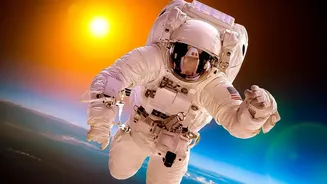
The distinctive gold coating on an astronaut's helmet visor is not for style; it's a critical piece of safety equipment. The microscopically thin layer of pure gold is incredibly effective at reflecting harmful infrared and ultraviolet (UV) radiation from the sun, protecting the astronaut's eyes and face. The polycarbonate of the visor itself blocks most of the remaining UV rays. The main body of the spacesuit also helps shield against radiation. Materials rich in hydrogen, such as the water circulating in the Liquid Cooling and Ventilation Garment and the suit's various polymer layers, are effective at slowing down and absorbing radiation particles. Future designs are even exploring wearable vests with targeted water or hydrogen-rich polymer shielding to better protect an astronaut's most sensitive organs on long-duration missions to the Moon or Mars.