
A New Map for a New Frontier
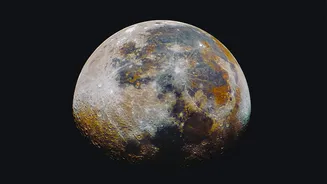
For decades, scientists debated the presence of water on the Moon. Early Apollo samples suggested it was completely arid. However, missions starting in the 1990s and accelerating in recent years have completely rewritten our understanding. Data from probes
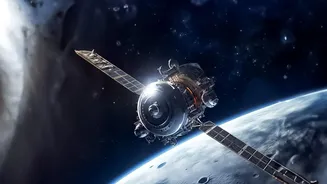
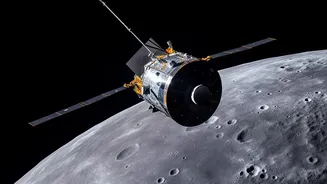
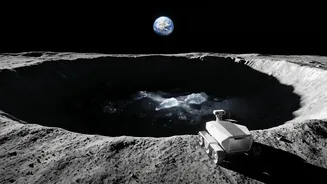
like India's Chandrayaan-1 and NASA's Lunar Reconnaissance Orbiter (LRO) provided the first definitive proof of water ice, particularly in permanently shadowed regions (PSRs) near the poles where sunlight never reaches. More recently, detailed maps created using data from the SOFIA airborne observatory have distinguished true water (H2O) from its chemical cousin hydroxyl (OH), revealing that water is more widespread than previously thought, even on sunlit surfaces. While some recent findings suggest surface ice may be less concentrated than once hoped, existing in smaller, patchy deposits, the focus has intensified on what lies beneath.
How They Are Finding the Ice
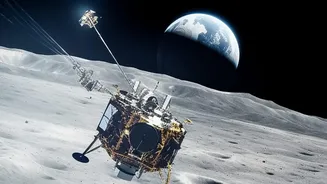
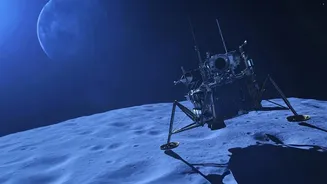
Locating this hidden resource requires a suite of sophisticated tools. Orbiters have used instruments like infrared spectrometers and advanced radar to detect the chemical signature of water from above. NASA's retired SOFIA telescope, for instance, could uniquely detect water's signature at a specific wavelength, allowing scientists to create the first wide-area maps of its distribution. Now, a new technique is generating excitement: seismic surveying. Researchers demonstrated in mid-2026 that by analyzing how vibrations from small, natural moonquakes travel through the lunar soil, or regolith, they can identify the distinctive signature of buried ice. Seismic waves are expected to travel much faster through ice-laden regolith than through dry soil. This method will soon be put to the test, with missions like China's Chang'e-7, scheduled to land in late 2026 with a seismometer, providing a real-world opportunity to validate these models.
The 'Gas Stations' of the Moon
The discovery of accessible water ice is about much more than quenching an astronaut's thirst. Its true value lies in its potential as a critical resource for in-situ resource utilization (ISRU). Water is the key ingredient for creating rocket propellant. Through a process called electrolysis, an electric current splits water (H2O) into its constituent elements: hydrogen and oxygen. When liquefied, these two elements form a highly efficient rocket propellant. The ability to manufacture fuel on the Moon would fundamentally change the economics of space exploration. It could transform the lunar south pole into a strategic refueling depot for missions venturing deeper into the solar system, such as to Mars.
Why This Changes Everything for Space Travel
The tyranny of the rocket equation has always been the biggest barrier to ambitious space travel. Launching anything from Earth is incredibly expensive, and much of a rocket's mass is the fuel it needs just to escape Earth's gravity. If spacecraft can leave Earth with only enough fuel to reach the Moon and then top up their tanks, the entire architecture of space exploration shifts. It frees up mass for more scientific equipment, larger habitats, or other vital cargo. This logistical advantage is central to the goals of NASA's Artemis program, which aims to establish a long-term, sustainable human presence on the Moon. Having a local source for breathable oxygen, drinking water, and propellant reduces dependency on costly resupply missions from Earth, making a permanent lunar base economically feasible.
From Maps to Mining: What's Next?
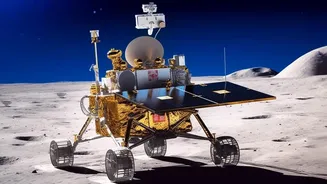
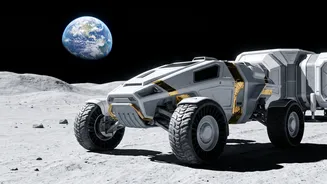
The current mapping breakthroughs are just the beginning. The next critical phase involves ground truth—confirming the remote sensing data with robotic and eventually human explorers on the surface. NASA's upcoming VIPER (Volatiles Investigating Polar Exploration Rover) mission is designed to do just that: it will venture into the shadowed craters to drill into the regolith and directly measure the concentration and composition of water ice. Missions like China's Chang'e-7 will also contribute vital data. As these prospecting missions refine our maps, engineers are already working on the technology needed for extraction and processing, such as NASA's CryoFILL project, which is testing systems to liquefy and store lunar-derived oxygen. These efforts are paving the way for Artemis astronauts to one day turn lunar ice from a scientific curiosity into a foundational resource for humanity's future in space.