








First, What Are Western Disturbances?
Unlike the familiar monsoon, Western Disturbances (WDs) are weather systems that originate over the Mediterranean Sea. These extratropical storms travel eastward, gathering moisture along the way, and bring crucial non-monsoonal precipitation to Northwest
India, primarily during the winter and pre-monsoon months. While they are vital for the rabi crop and for replenishing Himalayan glaciers, their character is changing. Climate change is making them more erratic and intense, leading not to gentle showers but to concentrated, high-intensity rainfall events that the mountainous terrain is ill-equipped to handle.
The Unique Danger in the Hills
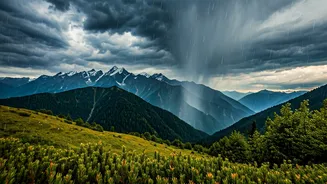
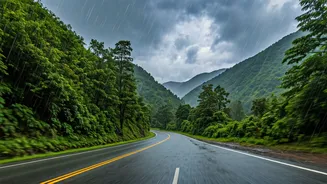
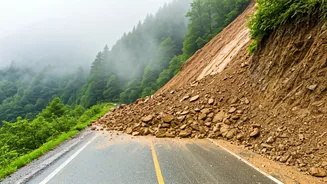
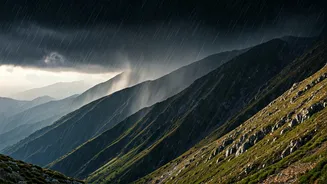
Rain in the plains and rain in the mountains are two entirely different beasts. On flat ground, water has time to spread out and be absorbed. In the steep, V-shaped valleys of the Himalayas, gravity takes over with terrifying speed. A flash shower can turn a gentle stream into a raging torrent in minutes, carrying with it boulders, uprooted trees, and debris. This leads to flash floods that can wipe out roads, bridges, and settlements downstream. Furthermore, the supersaturated soil on steep slopes, already destabilized by deforestation and construction, gives way, causing catastrophic landslides that can bury homes and block critical transport routes for days.
The Concrete Problem of Urban Sprawl
Our beloved hill stations like Shimla, Mussoorie, and Nainital were originally designed for much smaller populations. Today, they are grappling with rampant, often unregulated, construction. New hotels, homes, and shops are frequently built by cutting into hillsides and covering natural drainage channels with concrete. This 'urban sealing' prevents rainwater from seeping into the ground, forcing it to run off the surface at high velocity. This not only increases the volume and speed of floodwaters but also actively contributes to soil erosion and slope instability, making a bad situation significantly worse.
Fighting Back with Technology
Fortunately, authorities are no longer just reacting. The India Meteorological Department (IMD) has significantly improved its forecasting capabilities. Using a network of Doppler radars and automatic weather stations, the IMD can now issue more precise, location-specific warnings for heavy rainfall events. These alerts are disseminated through various channels, including SMS and mobile apps, to disaster management agencies and the public. This early warning system gives crucial lead time—sometimes a few hours—for authorities to evacuate vulnerable areas, halt traffic on dangerous routes, and prepare emergency response teams.
Engineering and Infrastructure Solutions
Beyond warnings, cities are investing in 'hard' infrastructure. This includes building more retaining walls to stabilize slopes, constructing check dams in streams to slow water flow and trap debris, and, most importantly, desilting and clearing colonial-era drainage systems that have been neglected for decades. Many cities are undertaking ambitious projects to map and restore natural water channels that have been built over. However, these solutions are incredibly expensive and technically challenging to implement on a large scale in fragile mountain ecosystems. Retrofitting an entire city is a slow and arduous process.
The Power of Community Response
Technology and infrastructure alone are not enough. The first responders in any mountain disaster are almost always the local community. State Disaster Response Forces (SDRF) conduct regular training and drills with village-level committees, teaching them basic search-and-rescue techniques and first aid. Local knowledge of safe routes, stable slopes, and traditional water management practices is invaluable. This community-led resilience, combined with official response mechanisms, forms a hybrid defence system that is critical for mitigating the loss of life and property during a flash shower event.