




The Great Dehydration
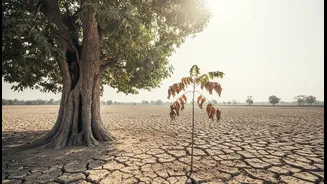
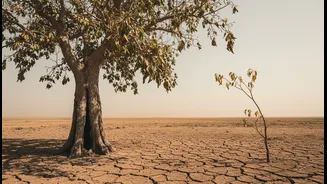
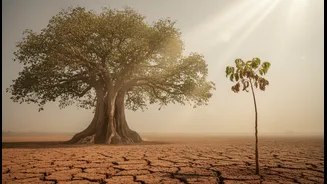
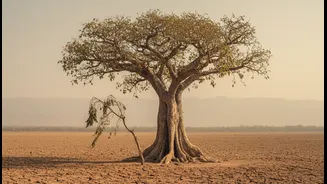
For a long time, scientists worked under a seemingly logical assumption: in a drought, smaller, younger trees with shallow roots would suffer most, unable to reach deep water sources. The giants of the forest, with their vast root systems tapping into
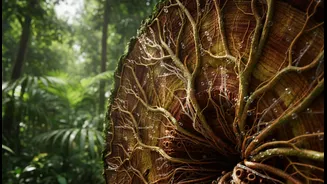
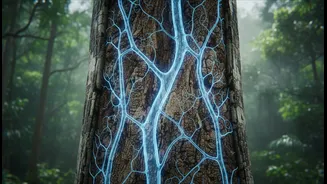
deeper reserves, were thought to be safer. However, recent studies are turning this idea on its head. It turns out that size and height are no guarantee of safety. In fact, the very height that makes these trees kings of the canopy also makes them uniquely vulnerable. The physical challenge of pulling water hundreds of feet into the air against gravity is immense. During a drought, as soil dries and water becomes harder to access, the tension on the water columns inside a tree's vascular system—its internal plumbing—increases dramatically. If that tension becomes too great, the water column can snap, creating a deadly air bubble, or embolism, that blocks water flow. This is akin to a tree dying of thirst, not from a lack of water deep in the ground, but from the inability to transport it to its leaves.
A Shared Risk, Different Reasons
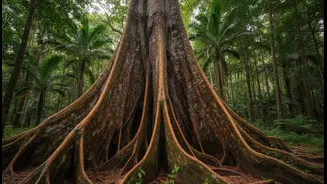
This creates a surprising parity of risk. Small trees suffer in the drying topsoil, while tall trees suffer from the sheer physics of their height. This concept of shared vulnerability means that entire forests, not just the undergrowth, are at risk when severe droughts hit. Research has shown that taller tropical forests can experience greater reductions in their water transport capacity during a drought compared to shorter forests. They are living closer to their hydraulic safety margins. However, some very recent findings suggest the story is even more nuanced. A 2026 study on giant dipterocarp trees in Borneo, some of the tallest tropical plants in the world, found they have evolved incredibly efficient internal plumbing, with wider vessels at their base to reduce the resistance of water flow. During a major drought, these specific tall trees did not show greater declines in growth than their shorter neighbours, challenging the idea that height alone is the determining factor.
Local Conditions Are Key
This is where the "complex local differences" come into play. A tree's ability to survive a drought isn't just about its height. It's a combination of its species-specific biology, its immediate environment, and the nature of the drought itself. Factors like soil type, which determines how much water the ground can hold, and local topography matter immensely. A tree in a low-lying, moist area may be less adapted to drought and more vulnerable when a truly severe one hits, compared to a tree on a dry slope that is already accustomed to water stress. Furthermore, not all droughts are the same. A failure of seasonal rains has a different impact than an unusually hot and dry season. Some species are 'isohydric', meaning they close their leaf pores (stomata) to conserve water, risking starvation from lack of CO2. Others are 'anisohydric', keeping their stomata open to photosynthesise but risking hydraulic failure. This mosaic of strategies and conditions means that predicting how a forest will respond is incredibly complex.
Why This Matters for India and the World
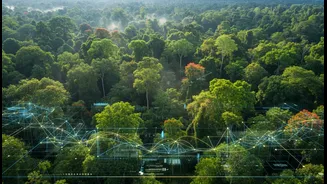
Understanding this complex vulnerability is critical. Tropical forests, including those in India, are massive carbon sinks, absorbing vast amounts of CO2 from the atmosphere. The health of these forests is directly tied to global climate stability. If widespread tree death occurs due to more frequent and intense droughts, these forests could flip from being carbon sinks to carbon sources, releasing huge quantities of stored carbon and accelerating climate change. This new understanding that both tall and small trees are at risk, but for different and locally specific reasons, forces scientists to rethink their models. It’s no longer enough to make broad predictions; conservation and climate modelling efforts must account for species-level traits and local environmental factors to accurately forecast forest health. It highlights the urgent need to protect intact, diverse forests, as this biodiversity may provide a crucial insurance policy against climate change.