





A Cosmic City of Ten Million Stars
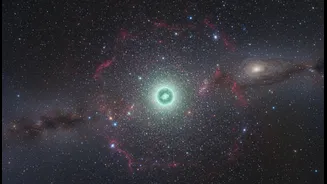
Imagine a sprawling, spherical city containing not thousands, but ten million stars, all packed into a space just 150 light-years across. That’s Omega Centauri, the largest and most massive of the 150-or-so globular clusters known to orbit our own Milky
Way galaxy. Located about 17,700 light-years away, it has fascinated observers for centuries. Unlike typical globular clusters, which are like quiet suburbs where all the stars are of a similar age and composition, Omega Centauri is a bustling metropolis. It contains multiple generations of stars, a characteristic that has long suggested it’s not a simple star cluster at all, but something more complex.
The Hunt for a Missing Link
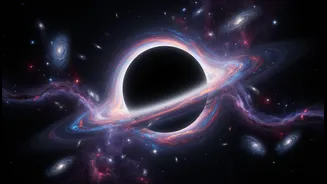
For years, scientists have suspected that Omega Centauri is the leftover core of a small dwarf galaxy that was long ago torn apart and partially swallowed by the Milky Way. One key piece of evidence for this theory would be the presence of a massive black hole at its center, something common in galaxies but not typically in globular clusters. Astronomers have been hunting for what’s known as an intermediate-mass black hole (IMBH), a celestial “missing link” between small, stellar-mass black holes and the supermassive giants found at the hearts of galaxies. Recent research in 2024, using two decades of Hubble Space Telescope data, provided strong evidence for just such an object, estimated to be at least 8,200 times the mass of our sun, by tracking the frantic movements of stars caught in its immense gravitational pull.
A New and Unexpected Discovery
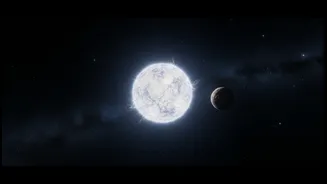
While the search for the central IMBH was a major story, another mystery has puzzled astronomers: where are all the smaller, stellar-mass black holes? Models predict that Omega Centauri should contain as many as 10,000 of them, formed from the collapse of ancient, massive stars. Yet, they have remained stubbornly hidden. Now, by combining over 20 years of Hubble data with recent, ultra-precise observations from the James Webb Space Telescope, a team has finally found one. They identified a visible star orbiting a dark, unseen companion. By tracking its slow, 94-year orbit—the longest ever found for such a pair—they determined the hidden object's mass is over four times that of our sun, too heavy to be anything but a black hole.
Rewriting a Violent History
This discovery, named oMEGACat BH-2, is more than just checking a box. The nature of the finding adds new layers of complexity to Omega Centauri's story. For one, the black hole's mass is surprisingly low for an object formed in a 'metal-poor' environment like this ancient cluster. This challenges theories about how black holes form from the first generations of stars. Furthermore, the incredibly long and wide orbit of the star and black hole suggests they weren't born together. Instead, the black hole likely captured a passing star in a chance gravitational encounter within the cluster's incredibly dense core. This single discovery opens a new window into the chaotic, dynamic processes that have shaped this strange and beautiful object over billions of years, confirming it as a unique laboratory for understanding both galaxy evolution and the lives of black holes.