


Why Hunt for Lunar Samples?
Bringing lunar material to Earth is considered a giant leap in space exploration. While rovers can perform experiments on the surface, studying samples in labs on Earth allows for analysis with equipment far too large or delicate to send into space. Scientists
can unlock secrets about the Moon's origin, its resources, and the history of our solar system. The primary goal of Chandrayaan-4 is to collect regolith—lunar soil and rock—from the south polar region, which is believed to contain water ice. This resource could be vital for future lunar bases, providing drinking water, breathable air, and even rocket fuel. A successful mission would make India only the fourth nation to achieve this feat.
A Masterclass in Complexity
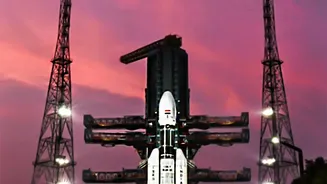
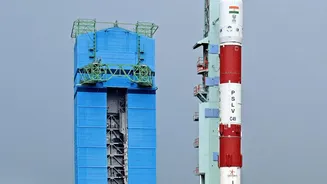
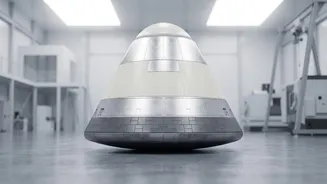
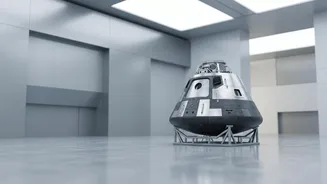
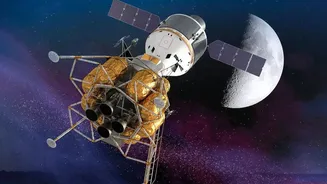
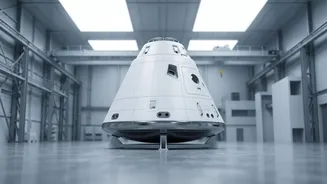
Chandrayaan-4 is not a single spacecraft but a complex, five-part system requiring two separate launches. ISRO's powerful LVM-3 rocket will be used for both launches. The five modules are the Propulsion Module, Descender Module, Ascender Module, Transfer Module, and a crucial Re-entry Module. This multi-stage architecture is necessary because the mission involves several complex steps that no single spacecraft could perform, including landing, collecting samples, launching off the Moon, and flying back to Earth. It's a technological challenge on an entirely new scale for ISRO.
The Two-Launch, One-Mission Plan
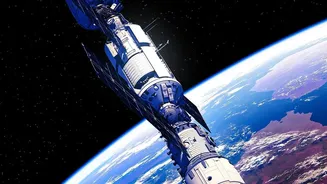
The mission begins with two LVM-3 rockets launching the five modules in two stacks. The first stack will carry the Descender and Ascender modules, while the second will launch the Propulsion, Transfer, and Re-entry modules. In a first for ISRO, these two stacks will perform an automated rendezvous and docking procedure while in Earth's orbit to form one integrated spacecraft. The combined craft will then use the Propulsion Module to travel to the Moon, demonstrating a critical capability needed for future human spaceflight missions.
Landing, Drilling, and Collecting
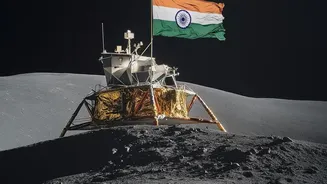
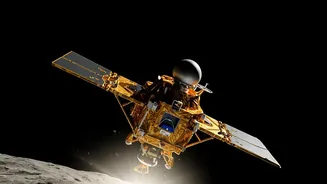
Once in lunar orbit, the Descender and Ascender modules will separate and perform a soft landing near the Moon's south pole, building on the success of Chandrayaan-3. After landing, a robotic arm on the Descender will collect surface samples. A drilling mechanism will also collect subsurface material, which is more likely to contain preserved water ice. These samples, weighing up to 3 kg, will be carefully transferred and sealed in a container aboard the Ascender Module to protect them from contamination and ensure the volatile ice crystals don't evaporate.
The Journey Home
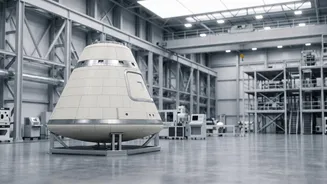
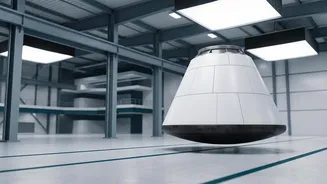
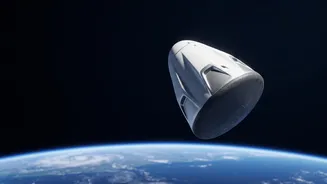
With the precious cargo secured, the Ascender Module will perform another mission first: launching from the lunar surface to rendezvous and dock with the Transfer Module waiting in orbit. The samples will then be transferred to the Re-entry Module. The Transfer and Re-entry modules will then begin the long journey back to Earth. As it approaches our planet, the Re-entry Module will separate, blazing through the atmosphere before making a safe landing, delivering its cosmic treasure to scientists back in India.