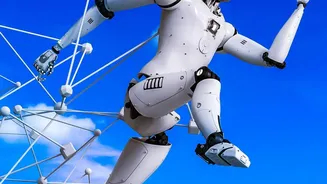








Meet Your New Digital Teammate
Forget the simple chatbots of the past. The new generation of AI in the workplace is far more advanced. Known as AI agents, these are sophisticated systems designed to go beyond just answering questions. They can plan, reason, and take action across multiple
steps and different software applications to achieve a goal. Think of an AI agent not as a tool you use, but as a digital assistant that can independently manage entire workflows. For example, an agent could be tasked with planning a product launch. It might then research competitors, analyze market data from your company's internal systems, draft a project plan, schedule meetings, and send follow-up emails, all with minimal human direction. This ability to autonomously execute complex tasks is what separates them from previous forms of AI.
The Promise: A Surge in Productivity and Innovation
For businesses, the opportunities presented by AI agents are enormous. The most immediate benefit is a massive boost in efficiency. These agents can automate repetitive, time-consuming tasks, freeing up employees to focus on more strategic, creative, and high-value work. This isn't just about saving time; it's about fundamentally changing how work gets done. By connecting and synthesizing information from disparate systems like CRMs, ERPs, and internal documents, AI agents can provide insights that would take a human hours to uncover. This empowers teams to make faster, more informed decisions. The result is an organisation that can scale its operations and handle larger workloads without a proportional increase in staffing costs. This also drives innovation, as employees are given more space for creativity when unburdened from administrative drudgery.
India's Rapid Embrace of an AI-Powered Workforce
India is emerging as a global frontrunner in the adoption of AI agents. A recent Microsoft report highlighted that Indian professionals are redesigning their work with AI agents at twice the global average, with one in three already using them for multi-step tasks. Major Indian IT firms like Infosys and TCS are leading the charge, deploying AI assistants to tens of thousands of employees to integrate AI into everything from software delivery to corporate functions. This rapid adoption shows that for India Inc., the idea of human-agent teams is no longer an ambition but a reality. Experts note that India is uniquely positioned to lead this shift, thanks to its deep technology talent pool and a workforce known for its rapid adoption of new digital skills.
The Other Side of the Coin: New Responsibilities
However, this powerful new technology comes with a new set of significant responsibilities. Granting AI agents autonomy to act within company systems introduces serious risks if not managed carefully. Data privacy is a primary concern; these agents often need access to sensitive company and customer information to function effectively, creating new vulnerabilities. Security is another major challenge, as a compromised AI agent could be manipulated by malicious actors to access systems, bypass security, or create automated fraud schemes. Furthermore, there is the risk of algorithmic bias, where agents trained on historical data perpetuate and even amplify existing biases in areas like hiring or performance evaluation.
Building the Guardrails for a Collaborative Future
Successfully integrating AI agents requires more than just deploying the technology; it requires building a robust framework of governance and ethics. Businesses must establish clear policies for how AI agents are used, monitored, and audited. A key principle is maintaining meaningful human oversight. AI should be seen as a collaborator that supports human judgment, not a replacement for it. This means creating 'human-in-the-loop' systems where critical decisions are still subject to human approval. Transparency is also crucial; employees and customers should understand how AI-driven decisions are made. Ultimately, the responsibility falls on leadership to define accountability—clarifying who is responsible for the actions and outcomes of these digital workers.