




The Universe’s Biggest Secret
Imagine throwing a ball into the air. You expect gravity to slow it down and bring it back to you. Now imagine it keeps going up, faster and faster. That’s essentially what our universe is doing. For decades, astronomers assumed the universe's expansion,
which started with the Big Bang, would be slowing down due to the gravitational pull of all the matter within it. But in 1998, observations of distant supernovae revealed the opposite: the expansion is speeding up. To explain this baffling phenomenon, scientists proposed the existence of a repulsive force, a sort of anti-gravity, which they named dark energy. It is now estimated to make up about 68% of the total mass-energy in the universe, with dark matter making up 27% and normal matter—everything we can see and touch—a mere 5%. This means the vast majority of our cosmos is made of something we cannot see, detect directly, or explain.
Meet CHIME: A New Cosmic Detective
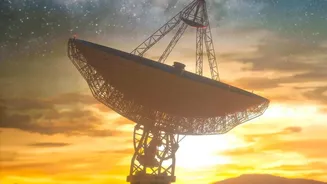
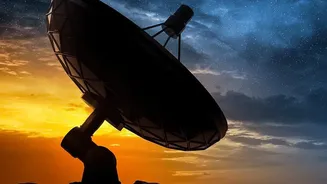
To solve this profound mystery, scientists need better maps of the universe's history. This is where the Canadian Hydrogen Intensity Mapping Experiment (CHIME) comes in. Located in British Columbia, CHIME is a revolutionary radio telescope with no moving parts, consisting of four large half-pipe-shaped reflectors. Instead of tracking individual galaxies, which is time-consuming, CHIME is designed to detect the faint radio glow from the most abundant element in the cosmos: hydrogen. By mapping the combined emissions of vast clouds of hydrogen gas across huge swathes of the sky, CHIME can create a three-dimensional map of how matter was distributed billions of years ago. This technique, called hydrogen intensity mapping, offers a faster and more cost-effective way to chart the universe’s expansion history compared to traditional galaxy surveys.
Using an Ancient Cosmic Ruler
CHIME’s method relies on a feature left over from the early universe called Baryon Acoustic Oscillations (BAOs). In the hot, dense plasma that existed just after the Big Bang, sound waves rippled outwards, creating spherical shells of matter. When the universe cooled and became transparent about 380,000 years later, these waves froze in place, leaving a faint imprint on the distribution of matter. These shells have a known physical size, which has expanded along with the universe. By measuring the apparent size of these 'standard rulers' at different points in cosmic history, astronomers can calculate the expansion rate with incredible precision. Recent results announced in late 2026 confirmed that CHIME can now detect these hydrogen signals on its own, a major milestone that proves its novel approach works and opens a powerful new window into the era when dark energy began to dominate.
Why the Mystery Endures
Even with powerful tools like CHIME and other projects like the Dark Energy Survey (DES), dark energy remains an enigma. The core of the mystery is that we don't know what it is. The leading theory is the 'cosmological constant,' an idea Albert Einstein proposed and later discarded. This suggests dark energy is a constant, intrinsic property of space itself—the energy of the vacuum. The problem is, when physicists use quantum theory to calculate how much this energy should be, the result is outrageously wrong—by over 100 orders of magnitude—from what we observe. Another idea is 'quintessence,' which proposes dark energy is a new kind of dynamic field that can change in time and space. Some recent evidence from projects like DESI suggests dark energy might not be constant, which would challenge the standard model of cosmology. A third, more radical possibility is that our theory of gravity is incomplete.