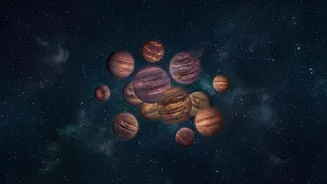



In the vast cosmic theater, some objects defy easy labels. New research, bolstered by data from NASA's SPHEREx telescope, reveals that brown dwarfs, often called 'failed stars', share more with gas giants than we ever thought possible.
Cosmic Misfits: What Are Brown Dwarfs?
Think of a brown
dwarf as a celestial object that had big dreams of becoming a star but never quite made it. They form the same way stars do: from the gravitational collapse of a giant cloud of gas and dust. However, they don't accumulate enough mass—the magic number is about 80 times the mass of Jupiter—to ignite the sustained nuclear fusion of hydrogen in their cores. This fusion is what powers stars like our sun and makes them shine. Brown dwarfs, falling short, can only muster enough pressure to fuse deuterium, a heavier type of hydrogen, and only for a short time. After that, they simply cool and fade over billions of years, wandering through space as dim, solitary objects. They occupy a mysterious middle ground, more massive than a planet like Jupiter, but not massive enough to be a true star.
A Surprising Atmospheric Connection
For a long time, astronomers have treated brown dwarfs as useful stand-ins for studying the atmospheres of giant exoplanets, which are much harder to see in the glare of their parent stars. A recent study using NASA’s SPHEREx (Spectro-Photometer for the History of the Universe, Epoch of Reionization, and Ices Explorer) mission has shown just how right they were. By analyzing the light from dozens of brown dwarfs across a wide temperature range, scientists found their atmospheres were chemically rich and complex. The data revealed clear signatures of water, methane, carbon monoxide, and carbon dioxide. These are the very same molecules we expect to find—and do find—in the atmospheres of gas giant planets. This suggests the underlying atmospheric physics and chemistry are remarkably similar, despite their different origins.
Blurring the Lines Between Planet and Star
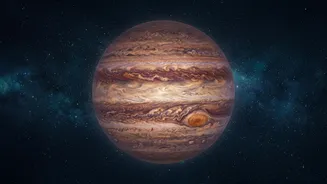
The latest findings are challenging our neat cosmic categories. Traditionally, the main difference between a brown dwarf and a gas giant was thought to be their formation story: brown dwarfs form in isolation like stars, while planets form from the disk of material orbiting a star. But if their atmospheres look and act so much alike, how different are they really? The new data shows that as brown dwarfs cool over time, their chemical makeup changes in ways that increasingly resemble giant planets. Some even show evidence of variable, layered clouds, not unlike the stormy, dynamic atmosphere of Jupiter. Recent findings from the James Webb Space Telescope on a cold brown dwarf named WISE 0855 detected water clouds and convection patterns similar to those on Jupiter, further cementing this connection. It seems the universe is less concerned with strict definitions than we are.
The Role of SPHEREx: A Mapper of Worlds
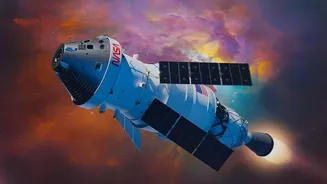
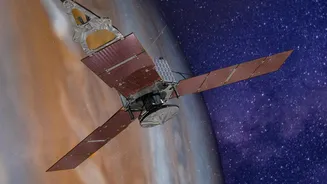
The SPHEREx mission, which began its survey in 2025, is uniquely suited for this work. Unlike telescopes like Hubble or Webb that focus on small patches of sky in great detail, SPHEREx is designed to map the entire sky. Every six months, it creates a new map of the cosmos in 102 different colors of light, mostly in the near-infrared spectrum. This all-sky approach is a numbers game; while the recent study focused on a few dozen brown dwarfs, SPHEREx is in the process of gathering spectral data on thousands more. This massive dataset will allow scientists to move beyond individual case studies and understand the entire population. It will help confirm whether the atmospheric similarities are a universal rule, and provide a treasure trove of 'local laboratories' for understanding the weather and chemistry of planets far beyond our solar system.