







The Morning Posture Promise
When you first sit down at your desk, your body is relatively fresh. The muscles that support your spine—like the erector spinae in your back and your core abdominals—are ready for action. You can sit upright with minimal effort, keeping your shoulders
back and your head aligned over your spine. In this state, the load on your musculoskeletal system is balanced and efficient. You feel alert, strong, and in control. But this ideal state is temporary, because holding any single position, even a 'good' one, is hard work for your body.
When Supporting Muscles Get Tired
Holding your body upright against gravity requires constant, low-level muscle contraction. Over several hours, these postural muscles begin to fatigue, just like any other muscle would during a workout. As they get tired, they lose their ability to hold your spine in an optimal position. To compensate, your body finds an easier, more passive posture: the slouch. Your head drifts forward, your shoulders round, and your lower back slumps. This posture requires less muscular effort but places significantly more strain on your ligaments and spinal discs.
The Problem with Inactivity
While some muscles fatigue from overuse, others become problematic from underuse. When you sit for hours, your hip flexors remain in a shortened position, causing them to tighten. Meanwhile, your gluteal muscles, which are crucial for pelvic and spinal support, effectively switch off. This combination of tight hip flexors and weak glutes pulls your pelvis forward into what’s known as an anterior pelvic tilt, increasing the curve and strain on your lower back. This imbalance is a primary driver of the lower back pain so many desk workers experience.
How Stillness Stiffens Your Joints
Joints are designed for movement. This movement circulates synovial fluid, a natural lubricant that keeps cartilage healthy and allows bones to glide smoothly. When you sit for prolonged periods, this circulation slows down, and the fluid can thicken. Without regular motion, joints in the hips, knees, and spine become stiff and less mobile. This is why you might feel creaky or stiff when you first stand up after a long meeting—your joints have temporarily lost some of their lubrication. Regular movement acts like a pump, keeping this vital fluid flowing.
Fight Fatigue with Micro-Movements
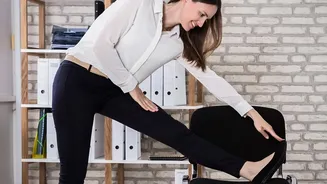
The solution isn't to find one 'perfect' posture and hold it all day. Instead, the goal is to introduce frequent changes in position. Experts recommend standing up, stretching, or walking for one to two minutes every 30 to 60 minutes. These 'movement snacks' don't need to be complicated. Simple actions like walking to get water, doing a few shoulder rolls, or performing a gentle spinal twist at your desk can make a significant difference. This breaks the cycle of static loading, improves blood circulation, and gives fatiguing muscles a much-needed break.
Simple Desk Exercises for Joint Mobility
To directly counteract the effects of sitting, incorporate simple mobility exercises into your breaks. For a stiff neck, try chin tucks, where you gently draw your chin backward to make a 'double chin'. To combat rounded shoulders, squeeze your shoulder blades together. A seated spinal rotation, gently twisting your torso from side to side, can help mobilise your upper back. To open up tight hips, try a standing hip flexor stretch by stepping one foot back into a lunge. These small, targeted movements help reverse the postural patterns caused by prolonged sitting.