



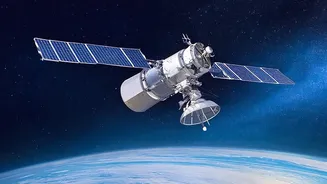
A New Space Age: From Government-Led to Private-Driven
India's space story is undergoing a dramatic transformation. While the Indian Space Research Organisation (ISRO) remains the bedrock of the nation's space ambitions, the sector is no longer a government monopoly. Policy reforms since 2020 have opened
the doors to private enterprise, creating a dynamic public-private ecosystem. The establishment of IN-SPACe (Indian National Space Promotion and Authorisation Centre) as a single-window regulatory agency is a key driver of this change. Its role is to enable private companies—from ambitious startups to established industrial giants—to participate in space activities, use ISRO’s world-class facilities, and build their own launch vehicles and satellites. This shift doesn't diminish ISRO's role; instead, it allows the national agency to focus on advanced research and development, deep-space exploration, and strategic missions like Gaganyaan, while private players drive manufacturing and commercial services.
The Startup Frontier: A Galaxy of New Employers
The most exciting development for engineering graduates is the explosion of space-tech startups. As of 2026, India is home to over 400 such companies, a number that has grown exponentially in just a few years. These firms are not just experimenting; they are launching rockets, building satellite constellations, and developing cutting-edge technologies. Companies like Skyroot Aerospace, which launched India's first private rocket, and Agnikul Cosmos, known for its 3D-printed engines, are creating launch vehicles. Others like Pixxel are building hyperspectral Earth-observation satellites, while Dhruva Space focuses on satellite platforms and deployment services. This startup boom, backed by significant venture capital, has created a competitive job market where demand for specialised engineering talent is soaring. Projections suggest the Indian space economy could grow from around $9 billion today to $44 billion by 2033, creating tens of thousands of new high-skilled jobs.
Beyond Rocket Science: The Diverse Roles in Demand
The modern space industry requires a far wider range of engineering disciplines than the traditional stereotype of an aerospace engineer suggests. While aerospace and mechanical engineers are still crucial for designing launch vehicles and spacecraft, the fastest-growing opportunities are in software, electronics, and data. Aerospace Software Engineers are needed to develop flight software and autonomous navigation systems. Electronics and Avionics Engineers design the complex communication, navigation, and control systems that are the brains of any mission. Furthermore, the massive amount of data sent back from satellites has created a booming field for Computer Science and AI/ML engineers, who work as Satellite Data Scientists and Remote Sensing Engineers, analysing information for applications in agriculture, climate monitoring, and urban planning. The sector also needs materials scientists, propulsion specialists, robotics engineers, and even legal experts to navigate space law.
Skills for Liftoff: What Aspiring Engineers Should Learn
A B.Tech in a core engineering discipline like Mechanical, Electronics, or Computer Science is the standard entry point. However, to be competitive in this new landscape, students must cultivate a multidisciplinary skill set. Proficiency in programming languages like Python or C++, and familiarity with simulation software such as MATLAB and CAD tools, is increasingly essential across all roles, not just software. Employers are looking for a deep understanding of physics, mathematics, and systems engineering. Experience with robotics, AI and machine learning, embedded systems, and data analysis will provide a significant edge. Companies are also hiring engineers from adjacent industries like automotive and telecommunications and reskilling them for the space sector, highlighting the importance of adaptable, hands-on problem-solving skills.
How to Prepare for a Career in Space
For students aiming for the stars, preparation starts on the ground. Actively seeking internships at space-tech startups or with ISRO is one of the best ways to gain practical experience. University projects, especially those involving satellite design (like CubeSats) or robotics competitions, are highly valued by recruiters. Building a strong professional network is also key. Following the major Indian space companies like Skyroot, Agnikul, and Pixxel on professional networking sites can provide insights into hiring trends and job openings. The space community in India is growing but remains close-knit, and direct outreach to founders and technical leaders can be effective. Above all, developing a habit of following industry news and understanding the technological and commercial trends shaping the sector will demonstrate a genuine passion that employers look for.