


A Faint Wanderer Emerges
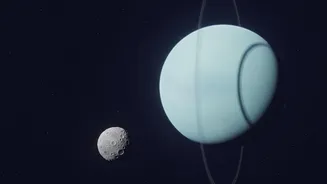
Astronomers have confirmed the existence of a new moon orbiting Uranus, the first to be discovered in over two decades. Provisionally named S/2023 U1, this celestial body is incredibly small, estimated to be only about eight kilometres in diameter, making
it likely the smallest of Uranus's known companions. It was first spotted in late 2023 using the powerful Magellan telescopes in Chile, and its existence was confirmed by reprocessing images taken as far back as 2021. This tiny moon follows a long, 680-day orbit far from the planet, on a path that is both highly elliptical and inclined. These characteristics immediately classify it as an 'irregular' moon, a category that offers tantalizing hints about the planet’s violent past.
Clues Hidden in a Chaotic Orbit
So, why is a tiny, distant rock so important? Its irregular orbit is the crucial detail. Unlike Uranus’s five major moons, which circle the planet in neat, equatorial paths, irregular moons have wild, tilted, and elongated orbits. Scientists believe these moons didn't form alongside Uranus but were instead captured from the Kuiper Belt, a vast ring of icy bodies beyond Neptune. The discovery of S/2023 U1 and the confirmation that its orbit is similar to two other irregular moons, Caliban and Stephano, strengthens a key theory. This suggests that a much larger parent body was once captured by Uranus's gravity and later shattered in a massive collision, leaving behind a family of fragments in similar orbital paths. Each new irregular moon helps piece together the story of these ancient cosmic smash-ups.
Uranus, the Sideways Giant
Understanding Uranus's moons is critical to understanding the planet itself. Uranus is famous for its extreme axial tilt of nearly 98 degrees, meaning it essentially orbits the sun on its side. This bizarre orientation, possibly the result of a cataclysmic impact with an Earth-sized protoplanet billions of years ago, makes its entire system unique. The event that tilted the planet would have profoundly disrupted the environment in which its satellites formed. Regular moons likely coalesced from a debris disk created by the impact, while the irregular moons were captured later. Studying the orbits and composition of both types of moons allows scientists to model what this chaotic period in the early solar system looked like and how the Uranian system settled into its current state.
A Growing, Irregular Family
The addition of S/2023 U1 brings Uranus's total number of known moons to 28. These satellites are divided into three main groups: the inner moons, the five major moons, and the outer irregular moons. The irregulars are particularly interesting because they serve as a sort of fossil record. Their orbits are constantly perturbed by the gravity of the Sun, and their surfaces are thought to be coated in dust from micrometeorite impacts, which can tell us about the material floating around in the outer solar system. Finding and tracking these faint objects is incredibly challenging, requiring special image-processing techniques to pick them out from the glare of background stars. This latest discovery demonstrates that even with our most advanced telescopes, there are likely more tiny moons waiting to be found.
Fueling the Case for a New Mission
This discovery comes at a pivotal time. A dedicated mission to Uranus is the highest-priority large-scale mission recommended by planetary scientists for the coming decade. The proposed Uranus Orbiter and Probe would be the first spacecraft to orbit the ice giant, providing an unprecedented up-close look at the planet, its mysterious rings, and its diverse collection of moons. After only a single flyby by Voyager 2 in 1986, countless questions remain. A new mission could investigate whether some of the larger moons hide subsurface oceans and analyze the composition of captured objects like S/2023 U1. Discoveries like this one underscore just how much we have yet to learn and strengthen the scientific case for returning to this enigmatic world.