

A Question of Age
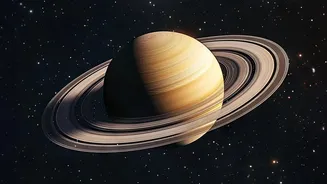
For a long time, scientists assumed the rings were as old as Saturn itself, forming 4.5 billion years ago from the same primordial cloud of gas and dust. However, data from NASA's Cassini spacecraft, which studied the planet for over a decade, has thrown
this idea into question. The rings are surprisingly clean and bright, made of almost pure water ice. Scientists argue that if they were ancient, they should have been darkened and polluted by a constant bombardment of micrometeoroids over billions of years. This led to a new theory: the rings are young, perhaps only 100 to 400 million years old, meaning they might have formed when dinosaurs roamed the Earth. Yet, the debate isn't settled. Some recent studies propose that the rings might be 'self-cleaning,' efficiently disposing of cosmic dust and thus appearing younger than they really are, potentially leaving the door open for an ancient origin.
An Uncertain Origin Story
If the rings are indeed a relatively recent addition, how did they form? The leading theories have one thing in common: violence. One popular hypothesis is that the rings are the shattered remains of an icy moon that strayed too close to Saturn. The planet's immense gravity would have torn it apart in a process known as tidal disruption, spreading its icy debris into the orbit we see today. Another theory suggests the rings could be the result of two former moons colliding and shattering. Supercomputer simulations have shown that such an impact could produce the right amount of ice-rich debris to form the rings. A variation on this idea involves a hypothetical moon, nicknamed Chrysalis, which was thrown into a destructive orbit after a complex gravitational dance with Saturn's giant moon, Titan. In this scenario, most of Chrysalis plunged into Saturn, while the rest blossomed into the beautiful rings we see now.
The Curious Case of 'Ring Rain'
The puzzles don't stop with the past; the rings' present behaviour is just as perplexing. Scientists have discovered a phenomenon dubbed 'ring rain', where particles from the rings are being pulled inward by Saturn's gravity and magnetic field. This isn't a gentle drizzle; it's estimated that an amount of water equivalent to an Olympic-sized swimming pool drains from the rings every half hour. This 'rain' has a significant impact on Saturn itself, influencing the composition and temperature of its upper atmosphere. Data from multiple spacecraft has revealed that this influx of ring material heats the planet's atmosphere, a process never observed elsewhere in the solar system. The material falling onto the planet isn't just water ice, but also includes silicates and complex organic compounds, giving scientists a unique opportunity to sample the rings' composition without sending a probe directly into them.
A Cosmic Disappearing Act
The discovery of ring rain leads to a startling conclusion: Saturn's rings are disappearing. This constant loss of material means they are not a permanent feature. Based on the rate of this 'rain' and other material falling onto the planet, scientists have made some dramatic predictions. Current estimates suggest the rings could be completely gone in as little as 100 million years. While that sounds like a long time in human terms, it's a fleeting moment on a cosmic timescale. This implies that humanity is incredibly lucky to exist in a brief window of the solar system's history when Saturn has this magnificent feature. If the rings are only a few hundred million years old and will only last for another hundred million, it makes their existence a truly special, and temporary, celestial event.