




The Powerhouse vs. The Artist
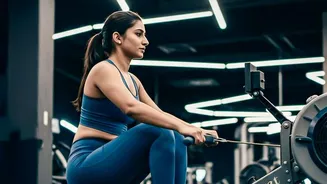
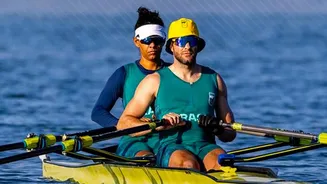
Imagine your lower body as an engine. Both rowing and dancing require this engine to produce force, but the instruction manual is entirely different. Rowing is about generating maximum power through a fixed, repetitive sequence. It's a closed-chain exercise
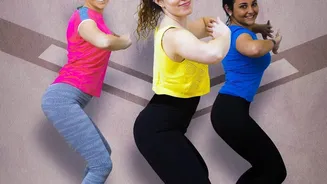
where your feet are fixed, and your body moves, demanding that your muscles fire in a precise, consistent order: legs, core, then arms. Dancing, on the other hand, is largely an open-chain activity. Your feet are constantly on the move, your body adapting to changes in rhythm, direction, and balance. It prioritizes reactive agility and spatial awareness over raw, linear power.
Rowing: The Rhythmic Engine of Repetition
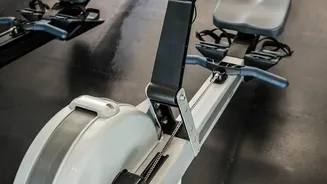
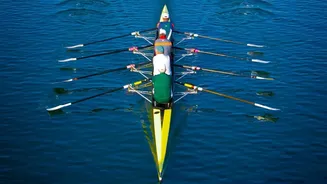
The rowing stroke is a masterclass in synchronized power. The 'drive' phase begins with a powerful push from the legs, primarily engaging the quadriceps and glutes. This force is then transferred up through the core and finally into the arms. The coordination here is about perfecting a predictable pattern to make it as efficient and powerful as possible. Elite rowers repeat this sequence thousands of time, training their neuromuscular system for endurance and consistency. The entire movement happens on a single plane—forwards and backwards—which hones a very specific, linear type of coordination. It’s about creating a perfectly repeatable, powerful stroke, again and again.
Dancing: The Art of Reactive Agility
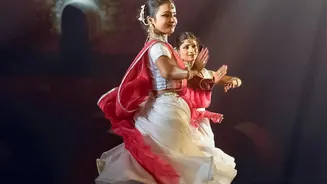
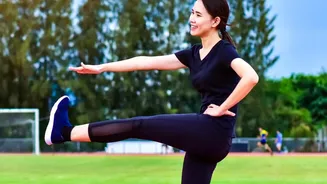
Dancing challenges coordination in a fundamentally different way. It demands that the body move not just forward and back, but side-to-side and rotationally, often in unpredictable ways. This requires exceptional proprioception—your body's 'sixth sense' for knowing where it is in space without looking. A dancer must constantly adjust to shifting weight, maintain balance on one leg, and coordinate complex footwork with arm and torso movements. Different styles place different demands: ballet requires immense control and external rotation from the hips, while hip-hop involves quick changes in level and explosive, percussive movements. This builds a highly adaptive, multi-planar coordination that excels at reacting to change.
Muscle Activation: Strength vs. Stability
While both activities build lower-body strength, they recruit muscles for different primary purposes. In rowing, the large muscles like the quadriceps, hamstrings, and glutes are the primary drivers of force. The goal is a powerful, concentric contraction to drive the body back. In dancing, these same large muscles are certainly used for power in jumps and leaps. However, there is an enormous emphasis on the smaller stabilizing muscles around the hips, knees, and ankles. These muscles work constantly to control joint position, manage landings, and maintain balance through a huge range of motion, often involving eccentric (lengthening) contractions that are crucial for control and injury prevention.
What's Your Fitness Goal?
Choosing between rowing and dancing comes down to what you want to achieve with your coordination. If your goal is to build powerful, rhythmic strength and cardiovascular endurance in a low-impact, symmetrical fashion, rowing is an exceptional choice. It creates a strong posterior chain (glutes, hamstrings, back) and a highly efficient, repeatable movement pattern. If your goal is to improve balance, agility, spatial awareness, and the ability to control your body through a wide variety of movements and rhythms, dancing is unparalleled. It trains your body to be adaptable, graceful, and coordinated across multiple planes of motion.