




A New Eye on the Cosmos
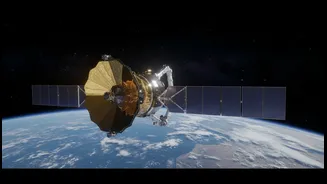
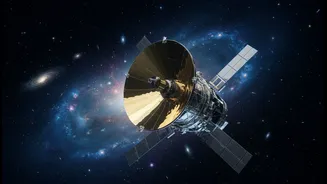
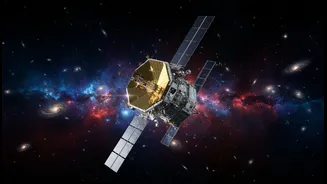
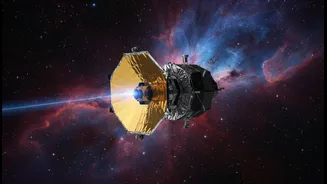
Scheduled to launch on August 30, 2026, the Nancy Grace Roman Space Telescope is NASA's next flagship observatory. Named after NASA's first Chief of Astronomy, this telescope is designed not to replace its famous predecessors like Hubble and Webb, but
to complement them with a unique and powerful capability: a panoramic view of the universe. While the Hubble and Webb telescopes are like microscopes, zooming in with exquisite detail on tiny patches of the sky, Roman is a wide-angle lens, built to survey vast cosmic territories quickly and efficiently. Its primary mission is not to give us another single, breathtaking image of a nebula, but to create enormous maps of the cosmos that will fuel scientific research for decades.
Seeing the Forest, Not Just Trees
The key to Roman's power is its Wide Field Instrument. It has the same size 2.4-meter mirror as the Hubble Space Telescope, giving it comparable image sharpness, but its field of view is at least 100 times larger. This means that in a single snapshot, Roman can capture an area of the sky that would take Hubble hundreds of images to piece together. Imagine trying to map a huge forest by looking through a drinking straw; that's the challenge for Hubble and Webb. Roman, by contrast, sees a panoramic vista. This survey capability is what makes it a discovery machine. It will scan billions of galaxies and stars, creating a massive dataset that astronomers can then mine for interesting targets.
Hunting for Planets in a New Way
While the Kepler and TESS missions found thousands of exoplanets by watching for the dimming of a star as a planet passes in front (the transit method), Roman will primarily use a different technique called gravitational microlensing. This happens when a star with a planet drifts in front of a more distant star from our perspective. The gravity of the foreground star and its planet acts like a lens, briefly magnifying the light from the background star. This method is especially good at finding planets that are further from their stars, in orbits similar to Earth's or Jupiter's, and even rogue planets that don't orbit a star at all. Roman is projected to find thousands of new exoplanets this way, providing a more complete census of the types of planetary systems that exist in our galaxy.
Illuminating the Universe's Dark Side
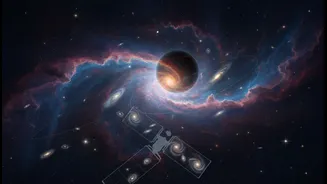
Beyond exoplanets, Roman has a primary mission to tackle two of the biggest mysteries in cosmology: dark energy and dark matter. Dark energy is the mysterious force causing the expansion of the universe to accelerate, while dark matter is the unseen stuff that provides the gravitational scaffolding for galaxies. Roman will study these phenomena by precisely mapping the positions of hundreds of millions of galaxies and observing thousands of Type Ia supernovae—exploding stars that act as standard candles to measure cosmic distances. By creating a 3D map of the universe across cosmic time, scientists can trace how dark energy has shaped the universe's expansion.
Why It's Not a Guarantee
The headline's caution comes from understanding Roman's role. It is a surveyor, a mapmaker. It will identify tens of thousands of supernovae and potentially hundreds of thousands of exoplanet candidates. But for most of these discoveries, especially those made via microlensing, they are fleeting, one-time events that are unlikely to be observed again. Roman will provide the statistical context—how many planets of a certain type exist, how the universe's expansion has changed—but it won't be able to study most of these individual targets in detail. That crucial follow-up work will fall to other telescopes, like the James Webb Space Telescope, which can then zoom in on the interesting locations Roman has identified. Roman's job is to create the ultimate treasure map; other explorers will have to investigate the treasures.