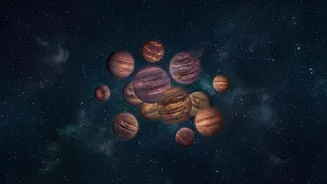






In the vast cosmic theatre, some objects don't quite make it to stardom. Known as brown dwarfs or 'failed stars', these celestial bodies are now revealing their secrets, thanks to new findings from NASA's SPHEREx telescope.
The Cosmic In-Betweeners
Imagine an object more massive
than Jupiter but not quite hefty enough to become a star. That's a brown dwarf. First theorized in the 1960s and confirmed in the 1990s, these objects form from collapsing clouds of gas and dust, just like stars do. However, they never accumulate enough mass to ignite the sustained hydrogen fusion that powers stars like our sun. Instead, they glow faintly from the residual heat of their formation, slowly cooling and fading over billions of years. This unique status makes them a fascinating bridge between the largest gas giant planets and the smallest stars, offering scientists a natural laboratory for studying atmospheric physics in conditions unlike any in our solar system.
A New Eye on the Sky Called SPHEREx
The instrument behind this new research is NASA's SPHEREx space telescope, which stands for Spectro-Photometer for the History of the Universe, Epoch of Reionization, and Ices Explorer. Launched in March 2025, its primary mission is to create a comprehensive map of the entire sky in 102 different colours of infrared light every six months. This all-sky survey helps astronomers tackle some of the biggest questions about the universe's origins and the formation of galaxies. While its main goals are cosmological, SPHEREx's powerful infrared vision makes it exceptionally good at spotting dim, cool objects like brown dwarfs. Studying these 'failed stars' is a valuable side project for the mission, providing a wealth of new data on objects that were previously difficult to observe in detail.
Familiar Chemicals in an Alien Atmosphere
In a study published in The Astrophysical Journal, scientists analyzed 37 nearby brown dwarfs using SPHEREx data. The observations revealed chemically rich atmospheres containing the distinct signatures of water, methane, carbon monoxide, and carbon dioxide. By measuring brightness across a wide infrared spectrum, the telescope can detect how these different molecules absorb light, creating a unique 'fingerprint' for each brown dwarf's atmosphere. While previous telescopes like the James Webb and Spitzer space telescopes have studied brown dwarfs, SPHEREx's broad spectral coverage is providing a new level of detail about their chemical makeup across a wide range of temperatures, from over 2,200 degrees Celsius down to a frigid minus 20 degrees Celsius.
Why Finding Water and Methane Matters
The detection of these specific molecules is significant because their presence and proportions change as a brown dwarf ages and cools. This allows scientists to test and refine their models of atmospheric chemistry. For instance, the data shows that as some brown dwarfs cool, their exotic clouds of silicate and iron particles begin to thin out, giving way to atmospheres dominated by methane. However, the study also found that current models struggle to explain the atmospheric details, as no two brown dwarfs look exactly alike, even at the same temperature. This variability suggests these worlds have complex meteorology. Researchers have jokingly referred to themselves as 'accidental meteorologists' due to the challenges of predicting the 'weather' on these bizarre objects. Understanding these atmospheres provides a crucial reference point for studying the atmospheres of giant exoplanets, which are much harder to observe due to the overwhelming glare of their host stars.