


Revisiting a Star System of Superlatives
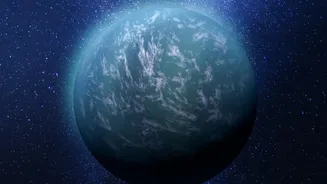
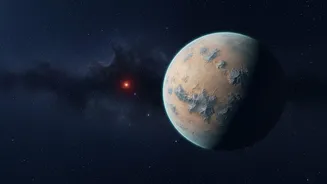
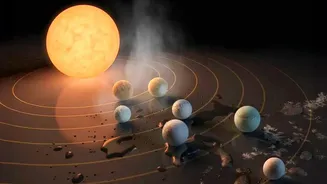
Ever since its discovery, the TRAPPIST-1 system has been a prime candidate in the search for life. It features seven rocky, Earth-sized planets orbiting a small, cool red dwarf star. Three of these planets are in the 'habitable zone', a region where conditions
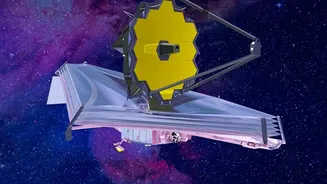
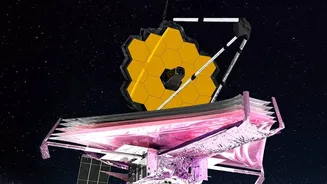
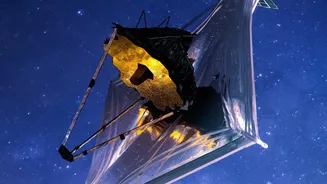
might be right for liquid water to exist. This unique arrangement, a compact family of terrestrial worlds, has made it a priority target for astronomers. Scientists have been eager to move beyond simply detecting these planets to actually characterising them, and the James Webb Space Telescope (JWST) is the tool that makes this possible. The hope has been to study their atmospheres for 'biosignatures'—chemical clues that could hint at the presence of life.
A Tale of a Venus Twin
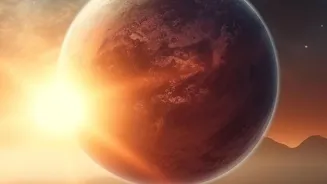
The focus of recent observations has been TRAPPIST-1 c, the second planet from the star. It is similar in size to Venus and receives a comparable amount of radiation from its star as Venus does from our Sun. This led to a tantalizing hypothesis: could TRAPPIST-1 c be a Venus twin, complete with a thick, carbon dioxide-rich atmosphere? A dense atmosphere acts like a blanket, trapping heat, and its composition can tell a story about a planet’s geology and potential for life. Using its Mid-Infrared Instrument (MIRI), the Webb telescope observed the planet as it passed behind its star, a technique known as secondary eclipse photometry. By measuring the tiny dip in brightness, scientists can calculate the heat radiating from the planet's dayside and deduce details about its atmosphere.
The Surprising Absence of an Atmosphere
The results, however, defied expectations. The telescope found that TRAPPIST-1 c is surprisingly hot on its dayside, with temperatures around 107 degrees Celsius. This high temperature suggests it does not have the thick, carbon-dioxide-heavy atmosphere that astronomers had postulated. A dense atmosphere would have trapped more heat, but it also would have absorbed specific wavelengths of light that Webb found to be present. The findings are consistent with two scenarios: either the planet is a bare rock with no atmosphere at all, or it has an incredibly thin atmosphere, much thinner than Earth's or even Mars'. This was a pivotal moment, demonstrating Webb's extraordinary ability to probe the environments of rocky, Earth-sized worlds so far away.
What This Means for the TRAPPIST System
The lack of a substantial atmosphere on TRAPPIST-1 c has significant implications. Red dwarf stars like TRAPPIST-1 are known for their intense stellar winds and high-energy radiation, which can strip away the atmospheres of closely orbiting planets. The findings for TRAPPIST-1 c, along with similar results for the innermost planet, TRAPPIST-1 b, suggest this process might be very effective. It could also mean that these planets formed with a relatively low amount of volatile compounds like water and carbon dioxide to begin with. If the planets throughout the system formed under similar conditions, this could lower the odds for the planets located further out in the habitable zone, as they too may have started with a limited reservoir of the ingredients necessary for life.