



A New Era of Cosmic Chemistry
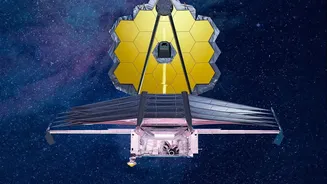
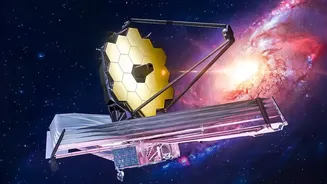
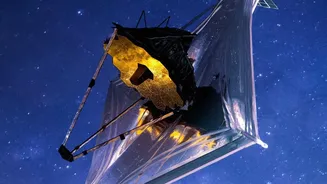
In the vast expanse of space, the James Webb Space Telescope (JWST) is acting as a cosmic detective, identifying the chemical building blocks of distant worlds. Its latest triumphs involve mapping the atmospheres of exoplanets—planets orbiting stars other
than our Sun—and repeatedly finding the unmistakable signature of water vapour. This isn't just a case of spotting a single molecule; the telescope's power allows for the creation of detailed atmospheric maps, revealing not just if water is present, but in what quantity and under what conditions. For planets like the hot gas giant WASP-96 b, early observations provided the clearest spectrum of water ever seen, confirming the presence of clouds and haze where they were once thought not to exist. This capability marks a profound leap from wondering what these planets are like to beginning to understand what they are made of.
How to 'See' Water from Light-Years Away
The JWST doesn’t 'see' water in the way a camera takes a picture. Instead, it uses a technique called transmission spectroscopy. When an exoplanet passes in front of its host star, a tiny fraction of the starlight filters through the planet's atmosphere. The gases in that atmosphere absorb very specific wavelengths, or colours, of light. Each chemical, whether it's water vapour, methane, or carbon dioxide, leaves a unique 'fingerprint' on the light's spectrum. By capturing this filtered light with its incredibly sensitive infrared spectrographs, the JWST can identify which molecules are present. It’s like analysing a rainbow that has passed through an alien sky and noting which colours are missing. This method is so precise that it can detect even trace amounts of water on planets hundreds of light-years from Earth.
From Gas Giants to Rocky Worlds
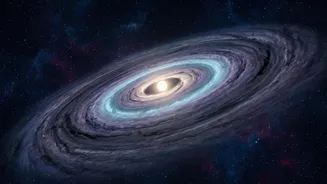
The telescope's discoveries span a wide range of planetary types. While initial detections on 'hot Jupiters' like WASP-18 b and WASP-96 b showcased the telescope's power, the ultimate goal is to study smaller, rocky worlds. The JWST has already provided tantalising hints of water vapour around rocky exoplanets like GJ 486 b. However, scientists exercise caution, as the signal could potentially come from cool spots on the host star itself rather than a planetary atmosphere. More excitingly, the telescope detected water vapour in the inner disk of the PDS 70 system, a region where rocky, Earth-like planets are thought to be forming. This suggests that the raw materials for water-rich worlds are available right from the start, a crucial insight into how planets like our own might come to be.
The Search for Habitable Worlds
Finding water is a monumental step in the search for life beyond Earth. While the presence of water vapour, especially on scorching hot gas giants, does not equal habitability, it is a critical piece of the puzzle. The technology proves that we can detect the primary ingredient for life as we know it across interstellar distances. The JWST is also capable of identifying other key biosignatures, such as methane and carbon dioxide. On the sub-Neptune exoplanet K2-18b, for instance, the telescope found both methane and carbon dioxide alongside water vapour, a combination that has generated significant scientific excitement. By studying the full chemical inventory of an exoplanet's atmosphere, scientists can build a more complete picture of its environment and assess whether it has the potential to support life. This comparative planetology helps us understand why some planets are barren and others, like Earth, thrive.