




Reading the Light from a Distant Sky
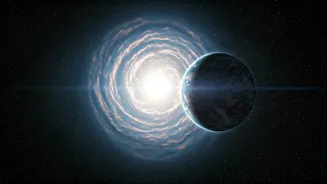
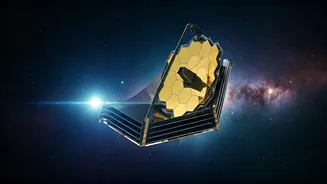
When an exoplanet passes in front of its star from our perspective, a tiny fraction of starlight filters through the planet's atmosphere. By capturing this light with powerful instruments like the James Webb Space Telescope (JWST), scientists can analyze
its chemical composition. This technique, called atmospheric spectroscopy, reveals a 'sky profile'—a breakdown of the gases present. Finding water vapour is a crucial first step, confirming that a key ingredient for a potential ocean is present. However, the presence of water vapour alone doesn't guarantee a liquid ocean; the planet could be a scorching world with a steamy atmosphere.
The Search for a 'Glint' in the Cosmos
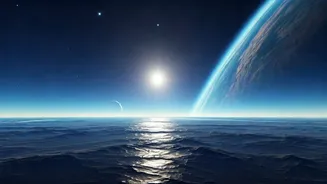
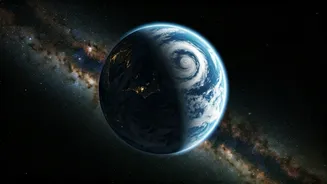
To confirm a liquid surface, astronomers are looking for more specific signals. One of the most promising is called 'glint,' or specular reflection. Think of how sunlight reflects off the surface of a lake or ocean on Earth, creating a dazzling bright spot. Scientists believe they can detect a similar glint from an exoplanet's ocean. As the planet rotates, this glint would appear to 'blink' as continents or clouds pass through the spot where the star's light is reflecting. Observing this periodic flash of light would be powerful evidence for a large, smooth liquid surface. However, clouds can also reflect light, so scientists must carefully model the planet to distinguish between the two.
Decoding Polarized Light and Chemical Clues
Another sophisticated technique involves analyzing the polarization of the light reflected from an exoplanet. Light becomes polarized when it bounces off a smooth surface like an ocean. By measuring the direction and intensity of these light wave vibrations, especially across different colours, astronomers can build a unique signature that points to an ocean. This method is less likely to be confused by clouds and can even provide hints about cloudiness itself. Beyond light tricks, atmospheric chemistry offers more clues. For example, some researchers suggest that a lower-than-expected amount of carbon dioxide in a planet's atmosphere, compared to its neighbors, could imply the gas is being dissolved into a large ocean. The absence of certain chemicals like ammonia can also point to an underlying ocean absorbing it from the atmosphere.
Hycean Worlds and Future Missions
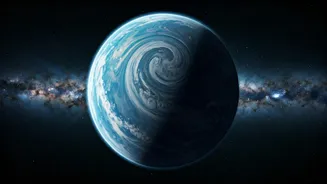
Recent discoveries have focused on a theoretical type of planet called a 'Hycean' world—a hot planet with a deep, global ocean under a hydrogen-rich atmosphere. The JWST has studied candidates like K2-18 b, finding some of the chemical markers consistent with such a world, though debate continues on whether the surface is truly temperate or boiling hot. These initial studies showcase the incredible power of our current telescopes. Future missions, like the proposed Habitable Worlds Observatory (HWO), are being designed specifically to detect these ocean signatures with even greater precision. The goal is to move from finding planets in the 'habitable zone' to directly confirming which of those worlds actually host the liquid water oceans necessary for life as we know it.