



What is the 'Tower Catch'?
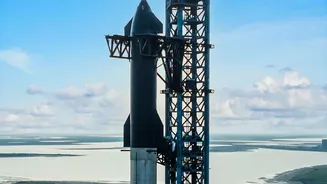
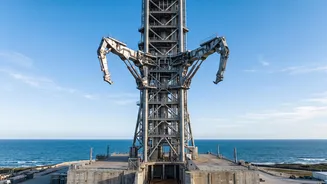
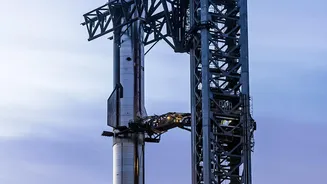
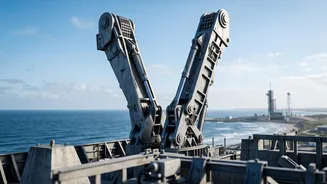
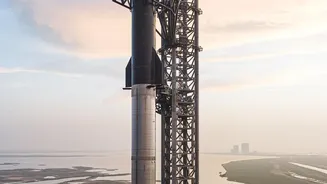
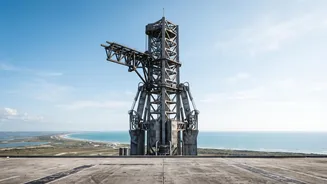
Imagine a 71-meter-tall rocket booster descending from the sky, firing its engines to slow itself to a near-hover just above its launch mount. Then, two massive arms, nicknamed 'Mechazilla', extend from the launch tower and close around the booster, catching
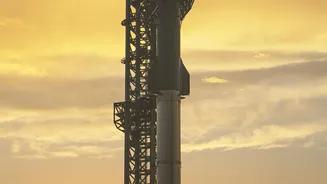
it before it touches the ground. This is SpaceX's tower-catch strategy in a nutshell. The system uses the structural strength of the orbital launch tower itself to serve as the landing infrastructure. Instead of the rocket carrying its own landing gear, the tower does the work of securing the vehicle, guided by an array of advanced sensors and powerful hydraulics.
From Landing Legs to Chopsticks
SpaceX already mastered rocket recovery with its Falcon 9, which uses landing legs to touch down on drone ships or landing pads. So why the radical change for Starship? The answer lies in mass and speed. Landing legs for the enormous Super Heavy booster would be incredibly heavy. Every kilogram dedicated to landing gear is a kilogram that can't be used for payload or fuel. By removing the legs, SpaceX makes the booster more efficient, able to lift more cargo for the same amount of fuel. This philosophy moves the complexity from the flight hardware to the ground hardware, which doesn't need to be launched into space.
The Need for Rapid Reusability
The core driver behind the tower catch is enabling airline-like operations for spaceflight. Recovering a Falcon 9 from a drone ship at sea takes time. The booster must be secured, brought back to port, transported to a facility, inspected, and then prepared for its next flight. A tower catch eliminates many of these steps. A booster or ship caught by the tower is already at the launch site, perfectly positioned to be inspected, stacked, and refueled for another mission, potentially within hours. This high launch cadence is essential for SpaceX's ambitious goals, such as building a self-sustaining city on Mars, which would require launching fleets of Starships in a short window every 26 months.
An Audacious Engineering Challenge
The precision required to catch a skyscraper-sized rocket is immense. The booster must navigate its descent with pinpoint accuracy to arrive between the 'chopstick' arms with near-zero velocity. A miscalculation could be catastrophic, potentially destroying both the multi-million dollar booster and the indispensable launch tower. This high-risk, high-reward approach is a hallmark of SpaceX's engineering philosophy. The company has incrementally built confidence through successive test flights, practicing the maneuvers with ocean landings before attempting the catch. While the company has now successfully caught its Super Heavy booster, catching the Starship upper stage—which re-enters from orbit at much higher speeds—remains a future milestone.
The Economic Imperative
Ultimately, the tower catch is an economic decision. Full and rapid reusability is the only way to achieve the dramatic cost reduction SpaceX believes is necessary to open up space. By making both the Super Heavy booster and the Starship spacecraft reusable like an airplane, the cost per launch is expected to plummet. This would not only support the deployment of its own Starlink satellite constellation but also fundamentally change the economics for commercial satellite operators and government partners like NASA, which depends on Starship for its Artemis moon missions. The strategy is a massive bet that the upfront complexity of the catch system will pay off through unparalleled operational efficiency down the line.