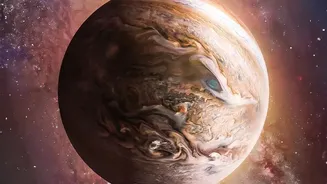


Imagine discovering a new world, only for it to vanish. Astronomers faced this exact puzzle with Fomalhaut b, an object once hailed as a landmark exoplanet discovery. Now, the mystery is solved, revealing a far more violent and chaotic story.
A Planet is Born? Or Is It?
In 2008,
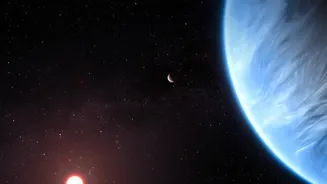
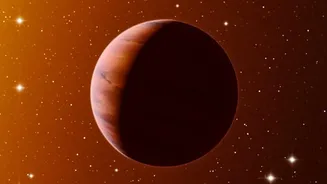
the world of astronomy was buzzing. Scientists using the Hubble Space Telescope announced the discovery of Fomalhaut b, a celestial body orbiting a bright star just 25 light-years from Earth. It was a huge deal because it was one of the very first exoplanets—planets outside our solar system—to be directly imaged. It appeared as a distinct point of light, a moving dot on a journey around its star. For years, it was celebrated as a breakthrough, offering a rare direct glimpse of a distant world. However, from the beginning, Fomalhaut b was a bit of an oddball. It was surprisingly bright in visible light, yet it gave off almost no infrared heat, which is unusual for a large planet. Astronomers theorized that perhaps a massive ring of dust surrounded it, reflecting starlight and creating the extra brightness.
The Case of the Vanishing World
The plot thickened as astronomers continued to track Fomalhaut b. Follow-up observations with Hubble showed that the object was not only following a strange, highly unusual orbit but was also gradually fading. Then came the biggest twist: in images taken in 2014, Fomalhaut b was gone. It had completely vanished. Planets, as a rule, don't just disappear. As one astronomer noted, the object was clearly not behaving like a 'bona fide planet'. The scientific community was left with a genuine mystery. Where did the planet go? Had it been destroyed? Or was the explanation something else entirely?
The Ghost in the Machine
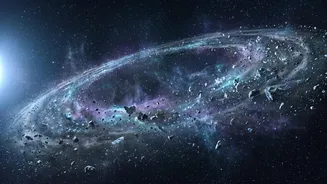
The solution, as it turned out, was more dramatic than anyone had initially guessed. A team of astronomers, led by researchers from the University of Arizona, re-examined all the archival Hubble data. They concluded that Fomalhaut b was never a planet to begin with. Instead, what the telescope had captured back in 2004 was the immediate aftermath of a titanic collision between two massive, icy bodies. The 'planet' was actually a vast, expanding cloud of very fine dust particles blasted into space by the impact. Each of the colliding objects was estimated to be about 200 kilometres across—giant comet-like bodies composed of ice and dust. What astronomers had witnessed was not the steady orbit of a planet, but the slow, dissipating ghost of this cataclysmic event.
Cosmic Detectives at Work
This conclusion neatly solved all the strange characteristics of Fomalhaut b. The cloud of fine dust would be bright in visible light as it scattered starlight, but too cold to radiate significant infrared heat. It would also expand over time, causing it to become fainter and more diffuse until it was no longer visible to Hubble—which is exactly what happened between 2004 and 2014. By tracking the object's path, scientists were able to reconstruct the event, noting that they had been at the 'right place at the right time to have witnessed such an unlikely event'. These cosmic smashups are believed to be a key part of how planetary systems form and evolve, including our own. For instance, the leading theory for the formation of Earth's moon is a collision between early Earth and a Mars sized body. Witnessing such an event in another star system provides a valuable real world laboratory.