







Beyond the Red Squiggle: What Are AI Draft Reviewers?
For years, students have relied on basic spell-checkers and grammar tools. But today's AI draft reviewers are in a different league. Powered by sophisticated artificial intelligence and large language models (LLMs), tools like Grammarly, ProWritingAid,
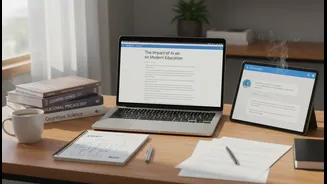
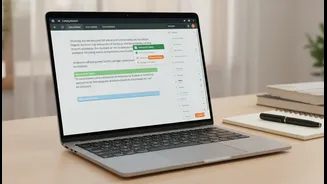
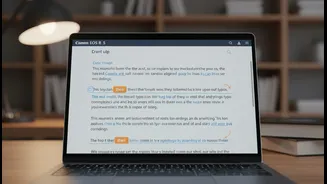
and integrated features within Microsoft Word and Google Docs can now analyse writing in a much deeper way. They go beyond identifying typos to provide feedback on style, tone, clarity, and structure, acting as an instant second opinion on your work. These tools are designed to help streamline and enhance academic writing, assisting in everything from planning a draft to the final proofread.
Decoding Readability: How AI Enhances Clarity
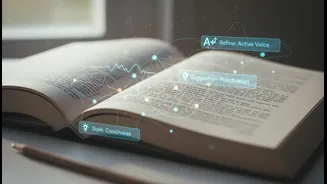
One of the primary benefits of AI review features is improving readability. Academic writing can often become dense and convoluted. AI tools are adept at flagging these issues. They identify overly complex sentences, suggest alternatives to jargon, and highlight excessive use of the passive voice, which can make writing feel distant and unclear. Some tools even provide a readability score, giving you a tangible measure of how easy your text is to understand. By offering suggestions to break down long sentences and choose simpler words, the AI helps you communicate your complex ideas more effectively, ensuring your arguments are not lost in confusing prose.
Finding Your Rhythm: Mastering Academic Flow
Good academic writing isn't just about clear sentences; it's about how those sentences connect to form a coherent argument. This is 'flow', and it's where AI is making significant strides. Modern AI can analyse the transitions between your sentences and paragraphs, ensuring your ideas are logically organised. It can highlight sections where an argument might be weak or disconnected and suggest ways to strengthen the logical progression. For students, this is invaluable. It’s like having a guide that checks whether your essay moves smoothly from introduction to conclusion, making sure every point builds effectively on the last.
The Smart Student's Guide to Using AI Tools
While powerful, AI writing assistants are tools, not replacements for your own thinking. The key is to use them wisely. Do not blindly accept every suggestion. Instead, treat the feedback as a prompt to re-evaluate your own writing. Ask yourself why the AI flagged a particular sentence. Does the suggested change improve clarity, or does it alter your intended meaning? The goal is to use these tools to become a better writer, not to have them write for you. Over-reliance can diminish critical thinking skills and even lead to issues with academic integrity if not used ethically. Always remember to use the tool for polishing and refining, not for generating the core ideas of your paper.
Choosing Your AI Writing Partner
The market is filled with options, many of which offer robust free versions perfect for students on a budget in India. Grammarly is a popular all-rounder, excellent for catching grammatical errors and improving clarity. Tools like QuillBot are known for their paraphrasing and summarizing capabilities, which can help in understanding complex source material. For more in-depth academic writing, tools like Trinka and Paperpal are specifically designed to handle scholarly phrasing and manuscript clarity. Many of these are available as simple browser extensions or are integrated directly into word processors, making them easy to access and use throughout the writing process.