


The 'Goldilocks' Promise
First, let's unpack what scientists mean by the habitable zone. Often called the 'Goldilocks Zone', it’s the orbital region around a star where a planet could, in theory, possess liquid water on its surface. Not too hot that the water boils away, and
not too cold that it freezes solid. Since all life as we know it requires liquid water, this seems like a perfect place to start looking for alien neighbours. When astronomers announce a new 'habitable zone planet', it's easy to imagine lush forests and sprawling oceans. The reality, however, is far more complex and, frankly, more interesting.
More Than Just Distance
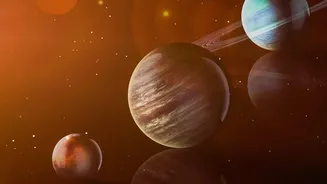
A planet's location is just one piece of a giant puzzle. Take our own solar system as an example. Venus, Earth, and Mars are all within or near the Sun's habitable zone. Yet, Venus is a toxic greenhouse inferno with surface temperatures hot enough to melt lead, and Mars is a cold, barren desert with an incredibly thin atmosphere. Clearly, being in the right neighbourhood isn't enough. The most crucial missing piece is the atmosphere. Its presence, thickness, and composition are what truly govern a planet's surface conditions. An atmosphere traps heat, shields from harmful radiation, and maintains the pressure needed for water to remain liquid. Without the right kind of atmospheric blanket, a planet in the perfect spot is still unlivable.
The Problem with the Parent Star
Not all stars are created equal, and the type of star a planet orbits is a major factor. The most common stars in our galaxy are red dwarfs. Their habitable zones are much closer to them than our sun's. This proximity, however, comes with a serious threat: red dwarfs are known for unleashing powerful stellar flares, especially in their youth. These flares can blast a nearby planet with radiation, potentially stripping away its atmosphere and sterilising the surface. Planets in these systems are also likely to be 'tidally locked,' meaning one side permanently faces the star in perpetual daylight while the other is frozen in endless night. This creates extreme temperature differences that would be a major challenge for life.
A Planet's Inner Workings Matter
What happens inside a planet is just as important as what happens outside. A planet's mass, for instance, determines if it has enough gravity to hold onto an atmosphere. Furthermore, an active geology, possibly driven by plate tectonics, may be necessary to regulate a planet's climate over billions of years. Most importantly, a molten core can generate a magnetic field. This magnetic shield is vital for protecting a planet's atmosphere from being slowly eroded by the stellar wind—a constant stream of charged particles flowing from its star. Without these internal dynamics, even a perfectly placed, watery world could lose its potential for life.
A New Era of Exploration
This is why scientists are so excited about new tools like the James Webb Space Telescope (JWST). We are finally moving beyond simply identifying planets in the habitable zone to actually studying what they're like. JWST can analyse the light that passes through an exoplanet's atmosphere, giving us a full menu of the atoms and molecules present. Recent discoveries have already revealed the atmospheric compositions of several worlds, spotting everything from water vapour to signs of active chemistry. This is the real next step: looking for the chemical fingerprints, or 'biosignatures,' that could indicate the presence of life. It’s about moving from a simple address to reading the mail.