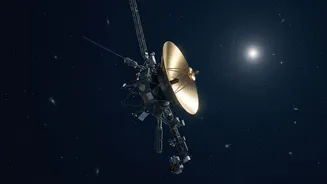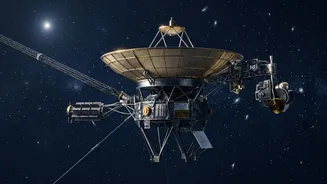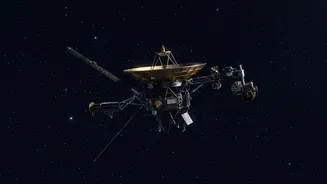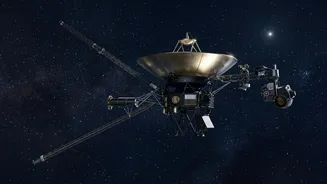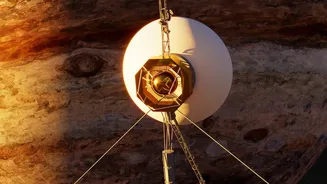

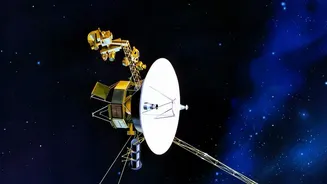
Far beyond the orbits of planets, a lone emissary from Earth is about to mark an unprecedented milestone. NASA's Voyager 1, launched in 1977, is nearing a distance of one light-day from home, the farthest any human-made object has ever gone.
A Journey Measured in Light
On November
18, 2026, after a journey of nearly 50 years, Voyager 1 will achieve a distance no probe has before: one light-day from Earth. So, what does that actually mean? A light-day is the distance light travels in 24 hours. Given that light moves at a staggering speed, this equates to roughly 25.9 billion kilometres. To put that into perspective, light from our Moon reaches us in 1.3 seconds, and sunlight takes just over eight minutes to travel from the Sun to Earth. Voyager 1 will be so far away that a radio signal, travelling at the speed of light, will take a full day to reach it. Sending a command and receiving confirmation will become a two-day affair. This incredible distance highlights not just the vastness of space, but the sheer tenacity of a machine built with 1970s technology, still phoning home from the void.
The Little Craft That Could
Launched on September 5, 1977, just weeks after its twin, Voyager 2, the primary mission for Voyager 1 was to study Jupiter and Saturn. It completed its planetary flybys with spectacular success, revealing the first active volcanoes beyond Earth on Jupiter's moon Io and exploring Saturn's complex rings. Having used a gravity-assist from Saturn to slingshot itself towards the edge of our solar system, its mission was extended. In February 1998, it officially became the most distant human-made object, surpassing Pioneer 10. Then, in August 2012, it made history by crossing the heliopause—the boundary where the Sun's influence ends—and entering interstellar space, the region between the stars. It has been travelling through this uncharted territory ever since, sending back data about an environment humanity has never directly measured before.
A Message in a Bottle
Beyond its scientific instruments, Voyager 1 carries a message for the cosmos: the Golden Record. This 12-inch, gold-plated copper disk is a time capsule containing sounds and images selected to portray the diversity of life and culture on Earth. Curated by a committee led by the famed astronomer Carl Sagan, it includes greetings in 55 languages, sounds of wind and rain, animal calls, and a 90-minute selection of music. Among masterpieces from Bach and Beethoven is a piece of India’s cultural heritage: the Hindustani classical raga 'Jaat Kahan Ho', performed by the legendary vocalist Surshri Kesarbai Kerkar. Its inclusion ensures that as Voyager 1 drifts silently through the Milky Way, a piece of India’s artistic soul journeys with it, a testament to our planet’s rich tapestry.
Phoning Home from the Void
Keeping a nearly 50 year old spacecraft operational is a monumental challenge. Voyager $^$1 runs on just $^$68 kilobytes of computer memory and communicates at a rate hundreds of thousands of times slower than modern broadband. Its power, supplied by decaying plutonium, diminishes by about four watts each year. To conserve energy, NASA engineers have been strategically shutting down instruments and heaters, a delicate process to keep the mission alive. The spacecraft has also given its team scares, including a recent communications glitch in October $^$2026 that silenced it for $^$48 hours before it mysteriously came back online. Earlier in $^$2024, a more serious five month silence was resolved by ingeniously reprogramming a corrupted memory chip from billions of kilometres away. These efforts highlight the incredible innovation required to maintain contact.
The Loneliest Wanderer's Future
This one light day milestone is likely the last major one Voyager $^$1 will report home. Though its two remaining active science instruments continue to study the interstellar medium, its power is finite. NASA estimates it will lose contact with the probe entirely around $^$2036. After that, it will go silent, but its journey will be far from over. It will take another $^$300 years just to reach the inner edge of the Oort Cloud, a vast $^$icy shell of comets at the fringe of our solar system. Travelling at over $^$61 thousand kilometres per hour,$^$ Voyager $^$1 is heading in the general direction of a star named Gliese $^$445,$^$ but it won't get close for another $^$40 thousand years.$^$ Its true destiny is to wander the Milky Way for millions of years,$^$ a silent ambassador from a small blue planet.