




A Cosmic Needle in a Haystack
Finding a potentially hazardous near-Earth object (NEO) is one of the greatest detection challenges in science. These asteroids are often small, sometimes no bigger than a large building, and incredibly faint. Many have dark, coal-like surfaces that reflect
very little sunlight, making them nearly invisible against the black backdrop of space. To make matters worse, they are moving at incredible speeds, covering vast distances in short periods. The search area is, quite literally, astronomical. Astronomers must scan the entire night sky, a seemingly infinite haystack, for a tiny, fast-moving needle that could appear from any direction at any time. The sun's glare can also create a massive blind spot, hiding any asteroids approaching from the 'day side' of Earth.
Giant Eyes on the Sky
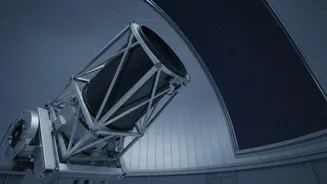
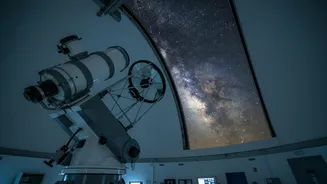
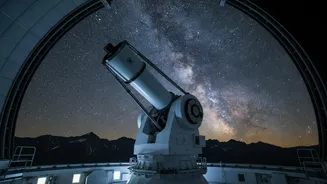
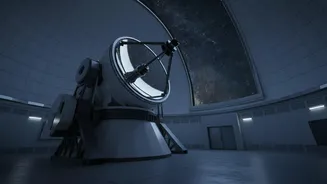
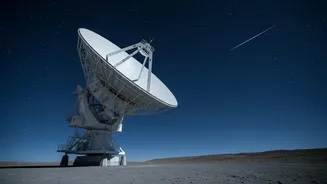
The first line of defense is raw power: large telescopes. Observatories like the Catalina Sky Survey (CSS) in Arizona and the Pan-STARRS system in Hawaii are the workhorses of planetary defense, responsible for the majority of NEO discoveries. These facilities use telescopes with large mirrors to gather as much faint light as possible. Soon, they will be joined by the Vera C. Rubin Observatory in Chile, a true game-changer. With its enormous 8.4-meter mirror and a 3,200-megapixel camera, Rubin will survey the entire southern sky every few nights with unprecedented sensitivity. This will dramatically increase the rate of discovery, allowing scientists to find smaller and more distant asteroids than ever before.
Finding Motion in the Stillness
A big telescope is only half the battle; the real magic lies in the software. The primary technique used to find asteroids is called 'difference imaging'. An observatory takes a series of pictures of the same patch of sky, typically three or four times over a short period. Sophisticated software then compares these images. Stars and galaxies remain fixed, but an asteroid will have moved slightly between each frame. The software flags these moving points of light as potential candidates. These candidates are then checked against a massive database of all known objects, maintained by the Minor Planet Center, to see if it is a new discovery. If it's new, an alert is sent out to a global network of observatories for follow-up observations to confirm its path.
Advanced Techniques for the Faintest Objects
For the dimmest and fastest-moving objects, even standard methods can fail. This is where more advanced algorithms come in. One powerful technique is known as 'shift-and-stack'. This method involves taking multiple images and digitally shifting and layering them based on the predicted path of a moving asteroid. This process causes the faint signal of the asteroid to build up and become visible, while the background stars are smeared into streaks. Furthermore, new algorithms like HelioLinc3D, developed for the Rubin Observatory, can link together sparse observations of an asteroid across multiple nights. This is crucial because Rubin will only image a spot twice per night, not the four times traditional methods require. These next-generation tools are essential for finding asteroids that might otherwise be missed.
A Global and Future-Facing Effort
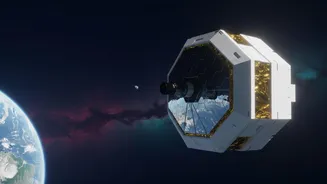
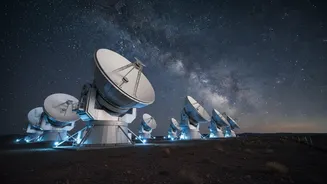
Planetary defense is a team sport. No single observatory does it all. The system relies on a global network of survey telescopes, follow-up observers, and data-processing centers working in concert. This includes contributions from space-based telescopes like NEOWISE and the James Webb Space Telescope, which can detect asteroids using infrared heat signatures rather than reflected sunlight. Looking ahead, dedicated space missions like the NEO Surveyor, set to launch in 2027, will be specifically designed to hunt for hazardous objects from space, filling in critical blind spots. Together, these ground and space-based assets form an ever-improving early-warning system, standing guard over our planetary neighborhood.