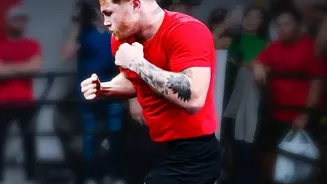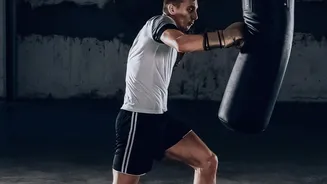







Looking for a workout that builds power, sharpens focus, and costs nothing? Shadow boxing uses controlled punches and footwork to deliver a full-body challenge, proving you don't need a bag or a ring to get a fighter's fitness.
What is Shadow Boxing?
At its core, shadow boxing
is a solo training method where you practice boxing movements against an imaginary opponent. It's not just about throwing punches into the air; it's a comprehensive drill that involves footwork, head movement, defensive manoeuvres, and strategy. Unlike hitting a heavy bag, which provides physical resistance, shadow boxing allows you to focus entirely on your form and technique without distraction. This makes it a foundational exercise used by everyone from first-time fitness enthusiasts to professional champions to refine mechanics, build muscle memory, and improve coordination.
The Full-Body Fitness Benefits
Shadow boxing is a surprisingly demanding full-body workout. Every punch is part of a kinetic chain that engages your legs, hips, core, and shoulders simultaneously. This constant, coordinated movement delivers a powerful cardiovascular workout, functioning much like high-intensity interval training (HIIT). A few rounds of continuous punching and moving will elevate your heart rate, burn calories, and build endurance. It also enhances balance and coordination, as you have to control your body's momentum without an external target to lean on. The result is a low-impact, high-reward exercise that builds functional strength and conditioning.
More Than Just a Physical Workout
The benefits of shadow boxing extend well beyond the physical. The practice demands immense focus and mental clarity. To do it effectively, you must visualize an opponent—reacting to their imagined attacks, creating angles, and setting up your own combinations. This act of mental rehearsal sharpens focus, improves reaction time, and builds what boxers call 'ring IQ'. It also serves as a powerful form of stress relief. The rhythmic movement and intense concentration provide a form of 'moving meditation', allowing you to channel frustration and release tension in a controlled, healthy way.
How to Get Started: The Basics
Getting started is simple, as you need no equipment and very little space. Begin with your stance. Stand with your feet shoulder-width apart. If you're right-handed, your left foot will be forward (orthodox). Your lead foot should point ahead, with your rear heel slightly raised. Keep your knees soft, hands up by your cheeks, and your chin tucked. Start by practicing basic footwork: moving forward, backward, and side-to-side without crossing your feet. Then, incorporate the fundamental punches. Focus first on the jab (a quick, straight punch with your lead hand) and the cross (a straight punch with your rear hand that involves rotating your hip and torso). Practice in front of a mirror to check your form.
Tips for an Effective Session
To get the most out of your workout, keep a few key principles in mind. First, always visualize an opponent; this transforms the drill from mindless movement to strategic practice. Stay relaxed and light on your feet, avoiding stiff, robotic movements. Focus on proper breathing, exhaling sharply with every punch. Structure your workout in rounds—for instance, three minutes rounds with a one minute rest in between, for a total of $15$-$20$ minutes. Don't sacrifice form for speed; slow , correct movements build better muscle memory. Finally , incorporate defensive moves like slips and rolls to make your practice more realistic and complete.