


A Star's Fiery Demise
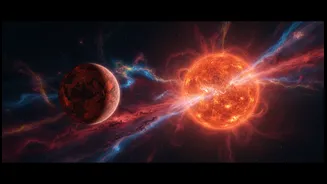
For a star like our Sun, the end begins when it runs out of hydrogen fuel in its core. Without the outward push from nuclear fusion, gravity takes over and the core contracts and heats up. This intense heat ignites fusion in the star’s outer layers, causing
it to swell dramatically into a “red giant.” In this phase, a star can expand to 100 times its original size, engulfing and destroying any planets unlucky enough to be in its immediate path. Our own Sun is expected to swallow Mercury, Venus, and possibly even Earth in about five billion years. After this violent expansion, the star sheds its outer layers, leaving behind a hot, dense core about the size of Earth known as a white dwarf.
How a Planet Survives
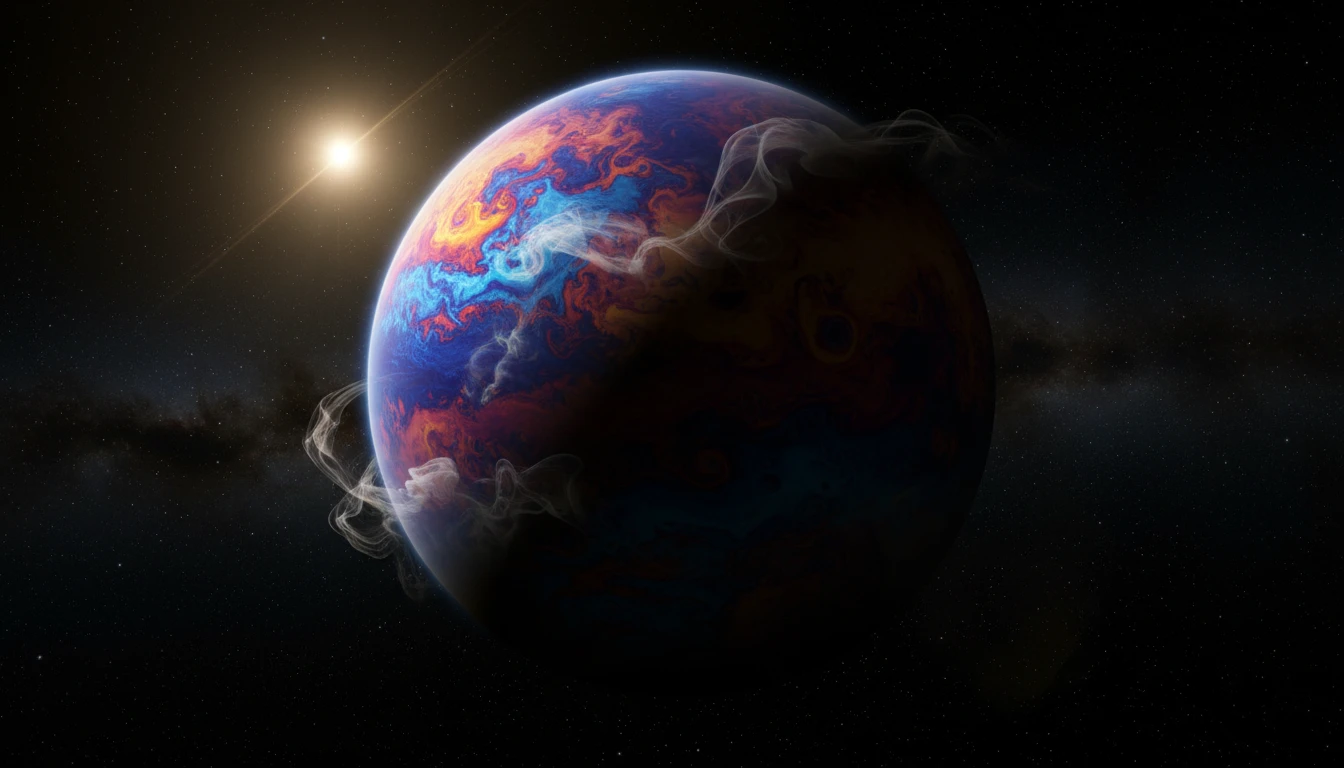
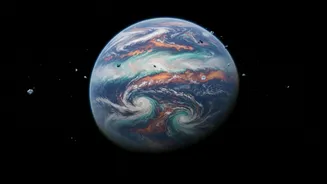
A planet's survival hinges on one simple factor: distance. Worlds orbiting far enough away from their star can escape being consumed during the red giant phase. Even so, it's a rough ride. The expanding star bathes these distant planets in extreme radiation, potentially boiling away atmospheres and oceans. Yet, as recent discoveries show, planets can and do endure. The key is to be outside the star’s maximum reach. For example, in our own solar system, Jupiter and the other outer planets are expected to survive the Sun’s red giant phase. They will be scorched, but their distance should prevent them from being completely destroyed.
The Great Orbital Shift
Surviving the star’s expansion is only the first part of the journey. The second act is a dramatic change in orbit. As the dying star sheds its outer layers and becomes a white dwarf, it can lose up to half of its total mass. With significantly less mass, the star’s gravitational pull on its surviving planets weakens considerably. This causes the planets to drift outward, settling into new, much wider orbits. A planet that once had a familiar path might end up twice as far from its star as it was before. The solar system is fundamentally rearranged, becoming a collection of distant worlds circling a dim, stellar remnant.
A Tale of Two Survivors
Astronomers have found compelling evidence of this process. One fascinating case is the planet WD 1856 b, a Jupiter-sized world orbiting a white dwarf. Scientists using the James Webb Space Telescope determined it likely survived at a safe distance and then, over billions of years, migrated into a new, incredibly close orbit due to gravitational nudges from other stars in its system. Another case, the planet Halla orbiting the giant star Baekdu, presents a different kind of survival mystery. Halla is so close to its star that it should have been engulfed, leading scientists to theorize that its star may have been part of a binary pair that merged, an event that prevented the star from expanding enough to destroy the planet. These discoveries show there is more than one way for a planet to cheat death.
A Glimpse into Our Future
Studying these strange, resilient systems gives us a preview of our own solar system's distant future. While Earth's fate is uncertain, the survival of giant planets around dead stars suggests that systems can endure even the most chaotic events. These discoveries challenge our understanding of planetary evolution, showing that the death of a star is not always the end for its family of planets. Instead, it can be the beginning of a new, quieter chapter in a system’s long life. Astronomers continue to search for more of these 'zombie' worlds, piecing together the story of cosmic survival and renewal.