


First, What's the Big Deal With Quantum?
Let’s get the basics out of the way. Traditional digital communication uses bits—a simple world of ones and zeros. It’s reliable, but its security relies on mathematical problems that are hard for current computers to solve. The problem is, future computers,
especially quantum computers, are expected to crack these codes with ease. This creates a “harvest now, decrypt later” threat, where adversaries can steal encrypted data today and unlock it tomorrow. Quantum communication flips the script. Instead of relying on math, it uses the laws of physics. One key method is Quantum Key Distribution (QKD), where information is sent via photons (particles of light). According to the principles of quantum mechanics, the very act of a hacker trying to observe these photons will disturb them, leaving behind undeniable evidence of eavesdropping. This makes the communication link not just hard to break, but fundamentally 'hack-proof.' It's a foundational shift from creating complex locks to creating a lock that tells you whenever someone tries to pick it.
Taking Quantum to the Heavens
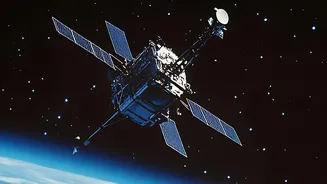
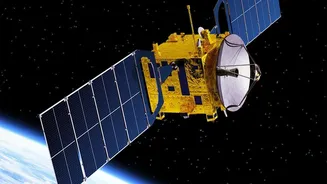
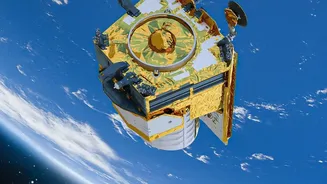
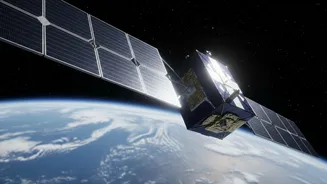
So, why bring satellites into it? While fiber optic cables can carry quantum signals, they suffer from signal loss over very long distances. Space, being a vacuum, is a much friendlier environment for sending fragile quantum information across continents. A satellite can act as a trusted node, generating and beaming down quantum keys to ground stations thousands of kilometers apart. This is crucial for everything from secure financial transactions to sensitive military communications. Satellites are the backbone of modern navigation, broadcasting, and defense systems, but they are also vulnerable targets for signal jamming, spoofing, and hacking. By equipping them with QKD capabilities, a country can create an unconditionally secure communication network that blankets its entire territory and connects it with allies abroad, immune to the looming threat of quantum computers.
India's Quantum Leap
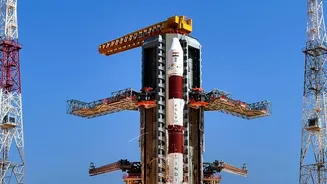
India isn't just theorizing; it's actively building this future. In April 2023, the Indian government approved the National Quantum Mission (NQM), a massive, eight-year initiative with a budget of over ₹6,000 crore (around $720 million). A central goal of this mission is to develop satellite-based secure quantum communication between ground stations up to 2,000 kilometers apart. The Indian Space Research Organisation (ISRO) is at the forefront of this push. Scientists at ISRO have already successfully demonstrated free-space QKD over a distance of 300 meters, using it for live, quantum-encrypted video conferencing. While 300 meters may not sound like much, it was a vital proof-of-concept, developing key indigenous technologies needed for the far more complex task of a satellite link. These efforts are supported by a network of specialized research hubs focused on quantum computing, communication, and sensing, positioning India to become a global leader in the field.
A New Front in the Global Tech Race
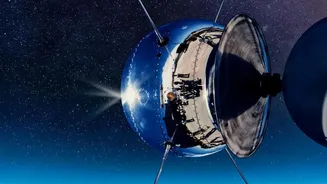
This push for quantum-secured satellites isn't happening in a vacuum. It's a strategic move with significant geopolitical implications. China has been a pioneer in this area, launching the world's first quantum satellite, Micius, back in 2016 and establishing its own quantum network. The United States and European Union are also investing heavily, recognizing that leadership in quantum technology is critical for future economic and national security. For India, developing sovereign quantum communication capabilities is a matter of technological self-reliance, or 'Atmanirbhar Bharat.' It reduces dependence on foreign technology for critical infrastructure and positions the nation as a formidable player in the 21st-century tech landscape. It's about securing its own vast digital economy, from banking to defense, against future threats while also creating a powerful new asset for diplomacy and strategic partnerships in an increasingly competitive world.