






The Universe’s Ultimate Heavyweights
Before we get to the spin, we have to talk about what a neutron star is. It’s one of the possible endpoints for a massive star after it goes supernova. When a star at least eight times the mass of our sun runs out of fuel, its core collapses under its own
immense gravity. The outer layers are blasted away in a spectacular explosion, but the core gets squeezed into an object of unimaginable density. Protons and electrons are crushed together to form neutrons, hence the name. The result is an object with a mass of maybe 1.5 times our sun, packed into a sphere just 12 miles across—about the size of Manhattan. A single teaspoon of neutron star material would weigh about ten million tons on Earth. They are, for all intents and purposes, city-sized atomic nuclei floating in space.
The Cosmic Ice Skater Effect
So, why the incredible spin? The answer lies in a principle you’ve seen at the Olympics: the conservation of angular momentum. Think of an ice skater spinning with her arms outstretched. As she pulls her arms in, her spin dramatically accelerates. The star that created the neutron star was also spinning, but very slowly—maybe once every few weeks. But as its core collapsed from hundreds of thousands of miles in diameter down to just a dozen, all of that rotational energy was conserved in a much, much smaller space. This is the ice skater effect on a cosmic scale, turning a slow, leisurely rotation into a mind-bogglingly fast one. The same amount of spin in a tiny package means it has no choice but to rotate at an incredible velocity.
Faster Than a Power Tool
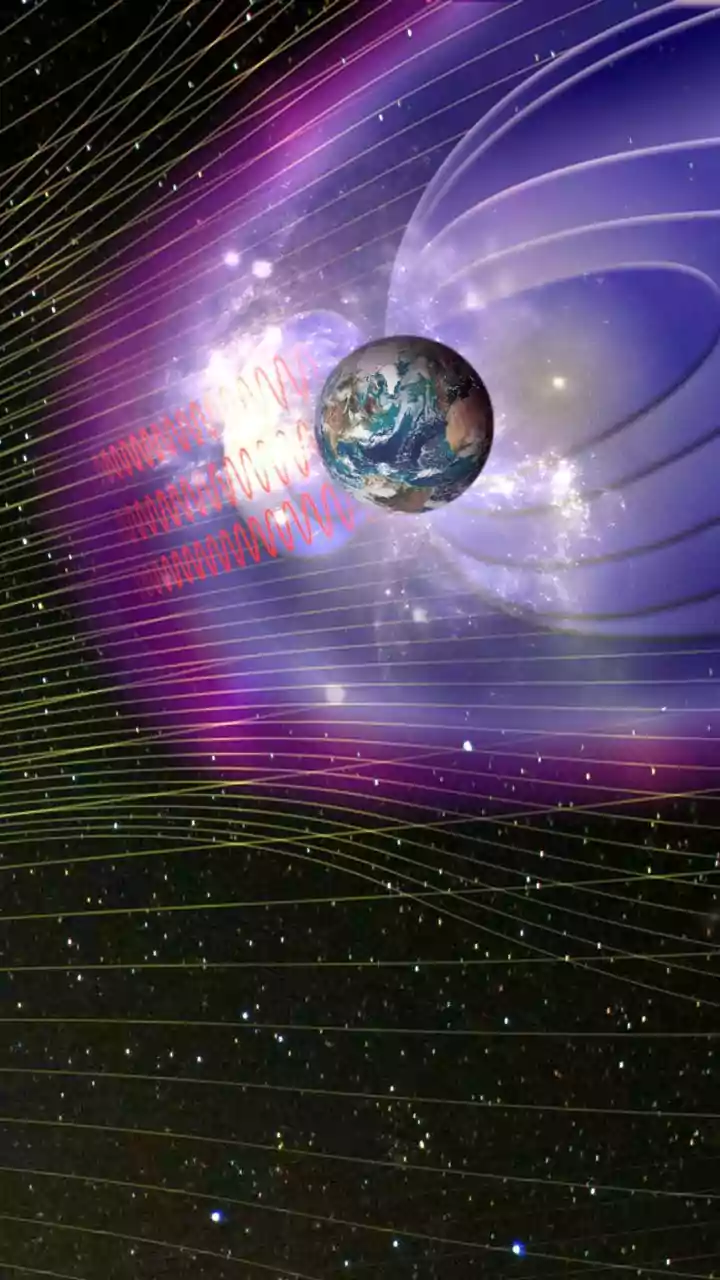
Let’s put “600 times per second” into perspective. That’s 36,000 revolutions per minute (RPM). A high-performance car engine redlines around 8,000 RPM. A kitchen blender might top out at 30,000 RPM. A neutron star, an object containing more mass than the sun, can spin faster than the blades in a Vitamix. And 600 times per second isn’t even the limit. The fastest known pulsar, a type of rapidly rotating neutron star that emits beams of radiation, is designated PSR J1748-2446ad. It spins at a dizzying 716 times per second. At its equator, the surface is moving at nearly a quarter of the speed of light. This incredible rotation powers intense magnetic fields trillions of times stronger than Earth's, which can sweep beams of light across the cosmos like a lighthouse, which is how we detect them as pulsars.
Living on the Brink of Destruction
With all that speed, a natural question arises: why don’t they just fly apart? The centrifugal force at the equator of these stars is immense, constantly trying to tear them to pieces. The only thing holding a neutron star together is its own ridiculous gravity. There is, however, a theoretical speed limit. Scientists calculate that if a neutron star were to spin much faster—somewhere around 1,200 times per second—the outward force at its equator would finally overcome its gravity. At that point, the star would begin to shed mass or break apart entirely. This means that the fastest-spinning neutron stars are truly living on the edge, rotating at a significant fraction of their absolute physical breakup speed. They are a perfect, violent balance between collapse and explosion.