

Finding the Planetary Shadow
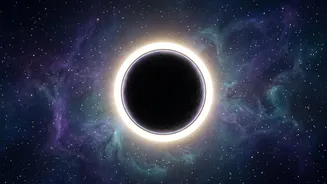
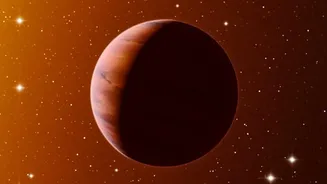
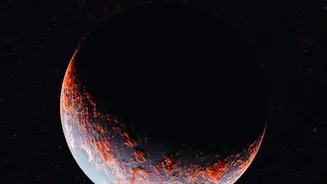
Before analysing an atmosphere, you first have to find the planet. Most exoplanets are discovered using the 'transit method'. This occurs when a planet passes in front of its host star from our perspective, causing a tiny, temporary dip in the star's
brightness. Think of it like a moth flying in front of a distant streetlight. While you can't see the moth itself, you can detect the slight dimming of the light. By observing a star over time, astronomers can spot these periodic dips, confirming a planet's presence and calculating its orbit and size. This transit event is the crucial first step, setting the stage for the JWST to perform its atmospheric detective work.
Starlight Filtered Through Alien Air
The real magic happens during that transit. For a brief period, the starlight we see has to pass through the very edge of the planet's atmosphere. This technique is called transmission spectroscopy. The planet's atmosphere acts like a massive, complex filter. Different gases and molecules within that atmosphere absorb very specific wavelengths, or colours, of light. Water vapour, methane, carbon dioxide, and other compounds each have a unique absorption 'fingerprint'. So, the light that finally reaches the telescope carries a hidden message—a chemical barcode of the air on that distant world.
The Power of Infrared Vision
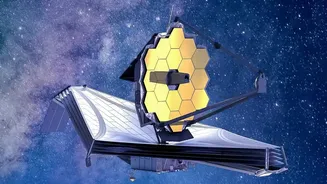
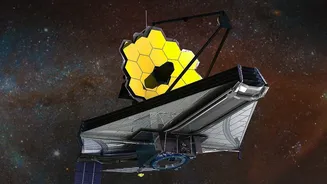
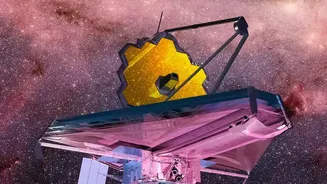
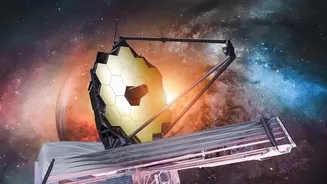
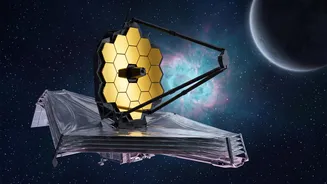
This is where the James Webb Space Telescope's specific design becomes essential. Webb is optimised to see the universe in infrared light, which is invisible to the human eye. This is critical because many key molecules, including water, have their strongest and most distinct absorption fingerprints in the infrared part of the spectrum. Previous telescopes, like Hubble, could do this to some extent, but JWST's larger mirror and advanced instruments provide unparalleled sensitivity and cover a much broader range of infrared wavelengths. This allows it to detect even faint traces of gases with stunning precision.
Decoding the Chemical Barcode
To read this barcode, JWST uses instruments called spectrographs, such as NIRSpec and NIRISS. A spectrograph takes the incoming starlight and splits it into its constituent wavelengths, creating a 'spectrum'—essentially a detailed rainbow. When astronomers compare the spectrum of the star when the planet is in front of it to the spectrum of the star by itself, they can see exactly which wavelengths of light are missing. These missing slivers of light, called absorption lines, correspond directly to the chemicals present in the exoplanet's atmosphere. A strong dip at the specific infrared wavelengths associated with water is the tell-tale sign that water vapour is present.
More Than Just Finding Water
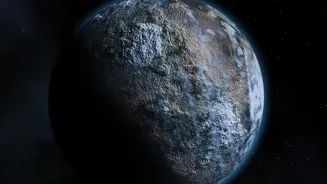
Detecting water is a landmark achievement, but transmission spectroscopy reveals much more. By analysing the full spectrum, scientists can identify a whole suite of molecules, from methane and carbon dioxide to sulfur dioxide. This helps them understand the overall composition, temperature, and even the presence of clouds or haze in the atmosphere. For gas giants, this information provides clues about how these massive planets formed and migrated in their solar systems. For smaller, rockier worlds, this same technique is our best tool in the search for potentially habitable environments, bringing us one step closer to answering the profound question of whether we are alone in the universe.