




Why Water Is the Cosmic Prize
Across the universe, the hunt for extraterrestrial life often boils down to a simpler search: the hunt for water. On Earth, liquid water is essential for every living thing we know. This makes it the most crucial ingredient scientists look for when assessing
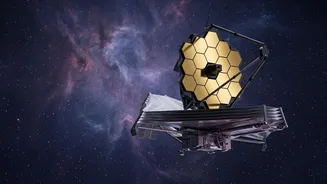
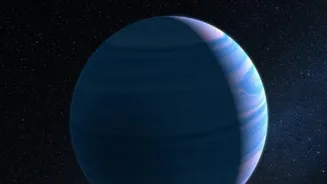
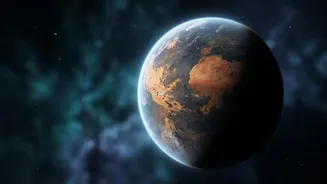
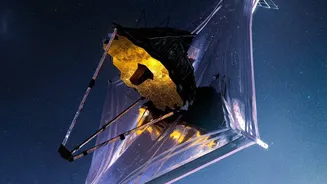
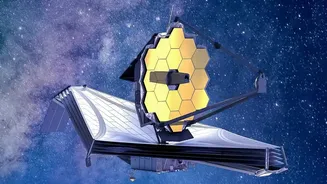
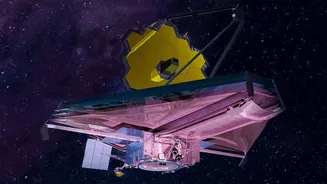
if a distant planet could possibly host life. Finding water vapour in the atmosphere of an exoplanet—a planet orbiting another star—doesn't guarantee life, but it confirms that a fundamental building block is present. It’s the first and most exciting clue that a world hundreds or thousands of light-years away might share a key characteristic with our own habitable planet. This is why a significant portion of JWST's mission is dedicated to sniffing out these faint, distant signals of H2O.
Catching Light Through an Alien Sky
To find water on a planet light-years away, astronomers need a bit of luck and a perfect alignment. The technique they use is called transmission spectroscopy, and it only works when a planet passes directly in front of its star from our point of view—an event called a 'transit'. As the planet transits, a tiny fraction of the star’s light filters through the planet’s atmosphere before continuing its journey to JWST’s mirrors. That starlight carries a hidden message. The gases in the planet's atmosphere absorb very specific colours, or wavelengths, of light. The telescope’s job is to catch this filtered light and analyse what’s missing.
The Power of Spectroscopy
At the heart of this process is spectroscopy—the science of splitting light into its constituent wavelengths, much like a prism creates a rainbow. Every chemical element and molecule has a unique 'barcode'. When light passes through a gas, the molecules in that gas absorb light at very specific wavelengths, leaving dark lines or dips in the spectrum. Water vapour has its own unmistakable signature. By capturing the starlight that has passed through an exoplanet’s atmosphere and splitting it into a spectrum, scientists can look for the tell-tale 'barcode' of water. If they see light missing at the exact wavelengths where water is known to absorb it, they can confidently say they have detected water vapour.
Webb’s Special Infrared Senses
This is where JWST’s design is truly brilliant. The telescope is optimised to see the universe in infrared light, which is invisible to the human eye. Molecules like water, methane, and carbon dioxide happen to absorb infrared light very strongly. Two of Webb’s key instruments for this task are the Near-Infrared Spectrograph (NIRSpec) and the Mid-Infrared Instrument (MIRI). NIRSpec can observe the light from over 100 objects at once, making it incredibly efficient. MIRI sees light at even longer infrared wavelengths. Together, they give astronomers a comprehensive view of the atmospheric chemistry of distant worlds. Previous telescopes, like Hubble, could detect water, but JWST’s superior sensitivity and infrared capabilities allow for much more detailed and robust detections.
From Faint Signal to Grand Discovery
When JWST observes a transit, it measures the tiny decrease in brightness as specific colours of light are absorbed. The data comes back as a graph showing the brightness of light at different wavelengths. A dip in this graph at a wavelength known to be absorbed by water is the 'signal'. For example, strong absorption bands for water exist around 1.4 and 1.9 micrometres in the near-infrared range. By analysing the depth and shape of these dips, scientists can do more than just confirm water's presence. They can estimate how much water vapour is in the atmosphere, its temperature, and even look for other key molecules. This turns a faint signal from a distant world into a detailed picture of its atmospheric composition, bringing us one step closer to understanding our place in the universe.