



Understanding 'Tech Neck'
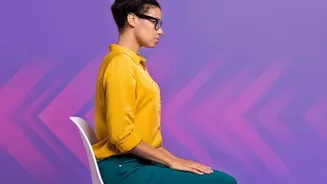
The posture you adopt while staring at screens—head tilted forward, shoulders rounded—is often called 'tech neck'. This position puts significant strain on your cervical spine. For every few centimetres your head drifts forward, the load on your neck muscles
increases substantially, leading to stiffness, pain, and long-term postural issues. The human body simply wasn't designed for hours of inactivity in this posture. Chair yoga offers a direct and accessible solution by introducing gentle movements to realign the spine, release muscle tension, and improve circulation without you ever having to leave your workspace.
Seated Cat-Cow
This foundational yoga pose is excellent for waking up the spine and can be easily adapted for your chair. Sit at the edge of your chair with both feet flat on the floor. Place your hands on your knees. On an inhale, arch your back, push your chest forward, and look slightly up toward the ceiling (Cow pose). As you exhale, round your spine, tuck your chin to your chest, and gently pull your belly button inward (Cat pose). Repeat this fluid movement for 5-10 breaths. This stretch mobilises the entire spine, relieving tension in both the neck and lower back.
Gentle Neck Rolls and Tilts
To directly target neck stiffness, start with some slow, mindful movements. Sit tall and drop your chin to your chest, feeling a stretch along the back of your neck. Hold for a few breaths. Then, slowly roll your right ear toward your right shoulder, holding for 15-20 seconds to stretch the left side. Return to the center and repeat on the left side. It's crucial to avoid rolling your head all the way back, as this can compress the spine. These gentle stretches release tension built up from looking at a screen.
Seated Spinal Twist
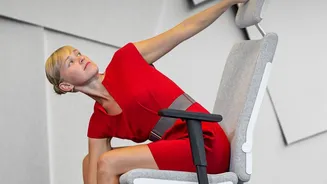
Twists are fantastic for relieving tension in the upper back and improving posture. Sit tall in your chair with your feet flat on the floor. On an exhale, twist your torso to the right, placing your left hand on the outside of your right knee and your right hand on the back of the chair for support. With each inhale, try to lengthen your spine, and with each exhale, deepen the twist slightly. Hold for 15-30 seconds, then gently release and repeat on the other side. This movement helps strengthen the abdominal muscles that support good posture.
Chest Opener Stretch
Hunching forward tightens the chest muscles and weakens the back. A chest opener counteracts this. While seated or standing, clasp your hands behind your back. Straighten your arms and gently squeeze your shoulder blades together, lifting your hands away from your lower back. You should feel a broad stretch across your chest and the front of your shoulders. Hold for 15-30 seconds while breathing deeply. This pose helps pull your shoulders back into proper alignment, correcting the rounded posture common among desk workers.
Seated Pigeon Pose
Tight hips can contribute to lower back pain, which in turn affects your overall posture. The seated pigeon pose targets this area effectively. While sitting, cross your right ankle over your left knee, keeping your right foot flexed to protect the knee joint. You should feel a stretch in your right hip and glute. For a deeper stretch, you can gently press on your right knee or hinge forward at your hips. Hold for 20-30 seconds, breathing into the stretch, then switch sides. This helps release tension that accumulates from prolonged sitting.