


Earth's Twisted Twin
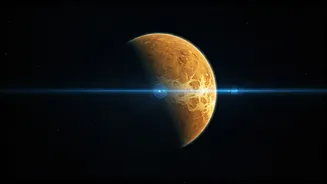
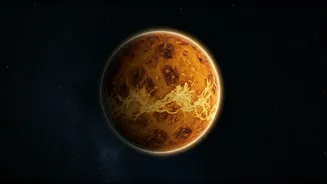
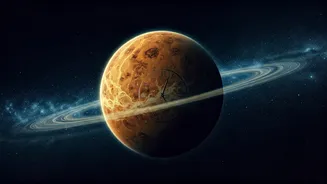
Venus is often called Earth’s twin. It’s similar in size, mass, and composition, leading scientists to believe it might have once been a temperate world like our own. But today, it’s a vision of hell, with a crushing carbon dioxide atmosphere and surface
temperatures hot enough to melt lead. As if that weren’t strange enough, its relationship with time is what truly sets it apart. The headline fact is mind-bending but true: one day on Venus is longer than one year on Venus. To understand this paradox, we have to rethink what we mean by a ‘day’ and a ‘year’.
A Year in a Flash, A Day That Drags
Let’s start with the year. A Venusian year, the time it takes to complete one full orbit around the Sun, is about 225 Earth days. This is fairly straightforward and shorter than our 365-day year because Venus is closer to the Sun. Now for the day. A 'sidereal day' is the time it takes for a planet to complete one full 360-degree rotation on its axis. On Earth, this is about 23 hours and 56 minutes. On Venus, this same single spin takes an incredibly long 243 Earth days. So, if you were standing on Venus, the planet would take 243 Earth days to spin once, but it would have already completed its trip around the Sun in just 225 Earth days. You’d have finished a year before you finished a day.
The Slow, Backward Spin
The cosmic weirdness doesn’t stop there. Venus spins in the opposite direction to Earth and most other planets in our solar system. This is called retrograde rotation. If you could stand on the Venusian surface (and survive), you would see the Sun rise in the west and set in the east. This backward, leisurely spin is the key to its temporal puzzle. While a full rotation takes 243 Earth days, the experience of a day-night cycle is actually different. A 'solar day' on a planet is the time it takes for the Sun to appear in the same position in the sky—for example, from one sunrise to the next. Because Venus is rotating backwards as it orbits the Sun, these two motions work against each other in a unique way.
Sunrise to Sunrise: A Different Story
This retrograde motion means a solar day on Venus is significantly shorter than its sidereal day. From one sunrise to the next, it takes about 117 Earth days. Think of it like walking backwards on a moving walkway. Even though you are moving slowly, your position relative to a fixed point changes faster. So, while a full spin takes 243 Earth days, you’d experience a sunrise approximately every 117 Earth days. This means there are almost two sunrises (two solar days) in every single Venusian year. It’s a world with two sunrises a year, where each day-night cycle lasts for nearly four Earth months.
Why Is Venus So Strange?
Scientists aren't entirely sure why Venus is such an oddball. The leading theory is that billions of years ago, a massive object—perhaps a planet-sized body—smashed into Venus. This cataclysmic impact could have been powerful enough to not just slow its rotation to a crawl but completely flip its orientation, causing the retrograde spin. Another theory suggests that the planet’s thick, heavy atmosphere created powerful tidal forces that, over billions of years, acted as a brake, slowing its rotation and eventually reversing it. The gravitational pull of the Sun on its dense atmosphere could have contributed to this effect. Whatever the cause, this slow, backward rotation makes Venus one of the most peculiar and fascinating destinations in our solar system.