

A New, Sharper Window on the Dawn of Time
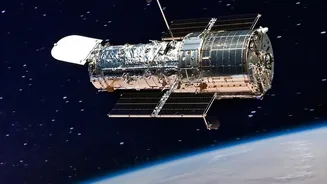
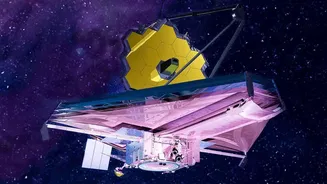
Before instruments like the James Webb Space Telescope (JWST), our view of the early universe was fuzzy at best. The Hubble Space Telescope gave us breathtaking images and proved the universe was changing over time, but its vision had limits. Light from
the most ancient galaxies is stretched by the expansion of the universe into infrared wavelengths, which are largely invisible to Hubble. This left the first billion years of cosmic history—the era when the very first stars and galaxies were born—shrouded in a cosmic fog. The prevailing theory, known as the Lambda Cold Dark Matter (ΛCDM) model, predicted a slow, gradual buildup. Small clouds of gas and dust were thought to have slowly come together, forming small, chaotic galaxies that grew over billions of years. JWST, with its giant mirror and unparalleled infrared sensitivity, was designed to pierce that fog and see the process unfold.
Finding Galaxies Too Big, Too Soon
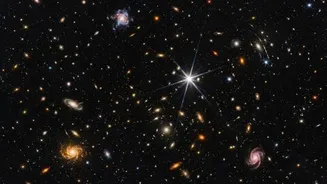
Almost immediately after it began operations, JWST started finding things that shouldn't exist according to the old models. The telescope delivered images of what appear to be huge, mature-looking galaxies from a time when the universe was just 500 to 700 million years old—a mere three percent of its current age. One study highlighted six candidate galaxies that were ten billion times as massive as our sun, with one appearing even larger than our own Milky Way, which had billions of more years to grow. This discovery was jarring. To form so quickly, these galaxies would have had to convert nearly all of their available gas into stars with an efficiency that scientists previously thought was impossible. The existence of these 'universe breakers,' as some nicknamed them, suggested something fundamental was missing from our understanding of galaxy formation.
Unexpected Complexity and Early Mergers
It wasn't just the size of these early galaxies that was surprising, but also their structure and behaviour. Astronomers expected to find small, isolated systems in the early universe. Instead, JWST has found evidence of complex interactions happening far earlier than predicted. In January 2026, researchers announced the discovery of an ongoing merger of at least five galaxies happening just 800 million years after the Big Bang. The data also showed that these collisions were already spreading heavier elements, like oxygen, through the space between galaxies. Furthermore, JWST has found that some of these massive early galaxies had already stopped forming stars, becoming 'quenched' much sooner than any model anticipated. This suggests the processes that end a galaxy's star-forming life were also operating on an accelerated timeline in the early cosmos.
Rewriting the Cosmic Playbook
These discoveries have sent theorists and astronomers back to the drawing board. While the findings don't necessarily break the standard model of cosmology itself, they are forcing a dramatic rethink of how galaxy formation works within that model. The wiggle room in the theories is getting squeezed. The early universe appears to have used the time it had with incredible efficiency. Scientists are now exploring new possibilities: perhaps star formation was vastly more effective in 'bursts' in the early days, making galaxies appear brighter and more massive than they truly are. Another idea is that the very first systems could have formed stars in a 'gangbusters' fashion, without the checks and balances that slow star formation in modern galaxies. These new, rich data sets are not just providing answers; they are raising deeper and more interesting questions about the dawn of everything.