

The Cosmic Recipe's Ingredients
When scientists talk about the 'building blocks of life', they are referring to complex, carbon-based organic molecules. These are not living organisms, but the essential, non-living components from which life as we know it is constructed. Think of them
as the flour, sugar, and eggs for a cosmic cake. Key among these are amino acids, which link together to form proteins — the workhorses of our cells, responsible for everything from building tissues to catalysing chemical reactions. Another crucial set of ingredients are nucleobases, the 'letters' that make up the genetic code in DNA and RNA. Without these fundamental carbon compounds, life on Earth would be impossible.
Icy Messengers from the Past
Comets are often called 'dirty snowballs' or 'time capsules' of the solar system. These icy bodies are primordial leftovers from the formation of our solar system, some 4.6 billion years ago. Because they spend most of their existence in the deep freeze of outer space, far from the Sun, the materials within them are exceptionally well-preserved. This makes them perfect subjects for studying the early chemistry of our cosmic neighbourhood. By analysing the dust and gas that a comet releases as it gets closer to the Sun, scientists can get a pristine look at the chemical cocktail that was present when the planets, including Earth, were just beginning to form.
The Evidence from a Comet's Trail
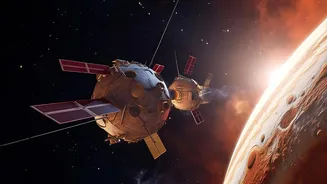
Groundbreaking space missions have provided unambiguous proof that comets are carrying these life-giving ingredients. The European Space Agency’s Rosetta mission, which orbited Comet 67P/Churyumov-Gerasimenko, made headlines with the first-ever definitive detection of the amino acid glycine in a comet's atmosphere. It also found phosphorus, a key component of DNA. The dust from Comet 67P was found to be about 50 percent organic material by mass, primarily in the form of large, complex macromolecules. Similarly, samples returned from asteroids like Ryugu by Japan's Hayabusa2 mission have shown a rich variety of organic molecules, including multiple types of amino acids and even all five nucleobases that form DNA and RNA. These discoveries confirm that these molecules aren't just theoretical but are actively present on these celestial bodies.
A Special Delivery to Early Earth?
So, how did these ingredients get from a comet to becoming the basis for life on our planet? This leads to a compelling theory known as panspermia, or more specifically, exogenesis. The idea is that in the early, chaotic days of the solar system, Earth was subjected to intense bombardment by comets and asteroids. These impacts, while destructive, could have delivered two of the most vital components for life: water and complex organic molecules. Instead of life's building blocks having to form from scratch in Earth's 'primordial soup', they may have arrived ready-made, delivered by these cosmic couriers. This would have given life a significant head start on a young, barren planet.
Ingredients, Not the Finished Cake
It is crucial to understand that finding these molecules is not the same as finding life. Scientists have found the chemical precursors, but not life itself. The presence of amino acids on a comet is like finding a bag of flour in a kitchen; it doesn't mean a cake will automatically bake itself. The transition from a collection of complex, non-living molecules to a self-replicating, living organism is a monumental step that remains one of science's biggest mysteries. What the comet findings do, however, is confirm that the necessary ingredients were available on early Earth, delivered from space.
A Universe Ripe for Life
The ultimate implication of these discoveries is profound and far-reaching. If comets and asteroids in our own solar system are rich with the building blocks of life, it suggests that these ingredients are not a special feature of Earth but are common throughout the cosmos. Comets form from the same primordial disks of dust and gas that create stars and planets everywhere. Therefore, it is reasonable to assume that other solar systems are also being seeded with these same organic compounds. This dramatically increases the odds that, somewhere out there, the conditions might be right for these ingredients to come together and spark the process of life, just as they did on our own world.