

The Coming 'Quantum Apocalypse'
Right now, your bank transfers, private messages, and government secrets are protected by encryption. Think of it as a complex mathematical lock. For today's computers, trying to pick that lock by guessing the combination would take billions of years.
But the era of quantum computing is approaching. These revolutionary machines process information in a fundamentally different way, allowing them to solve certain problems with astonishing speed. For a powerful quantum computer, breaking today's strongest encryption won't take billions of years; it could be a matter of hours. This creates a terrifying scenario security experts call the 'quantum apocalypse' or 'Q-Day'. Adversaries—be they rival nations or sophisticated criminals—are already believed to be practicing a 'harvest now, decrypt later' strategy: recording massive amounts of encrypted data today, waiting for the day they can unlock it all.
A Lockdown in the Sky
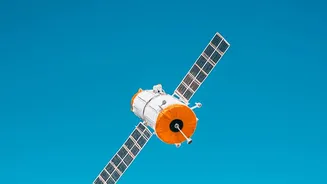
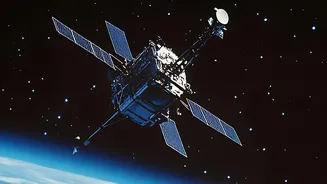
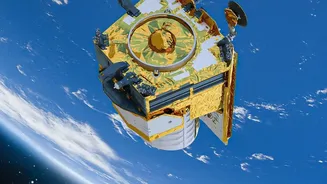
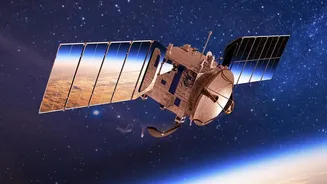
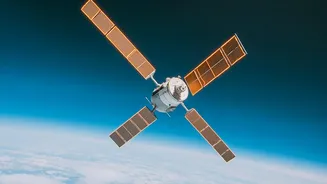
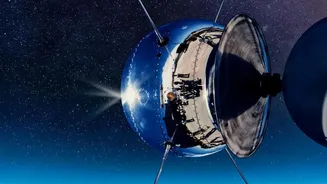
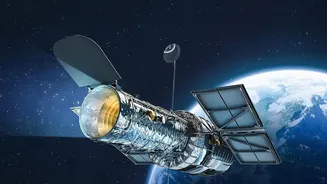
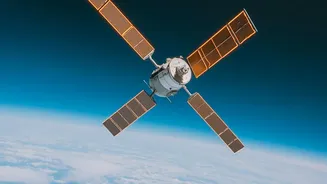
The solution sounds like science fiction: using the laws of physics to create perfect security. It’s called Quantum Key Distribution (QKD). Instead of relying on math problems, QKD sends a secret key encoded onto individual particles of light, or photons. The core principle of quantum mechanics states that the very act of observing a quantum particle changes it. If an eavesdropper tries to intercept the photons to steal the key, they will inevitably alter them, immediately alerting the legitimate users that the channel has been compromised. It's like a letter with a seal that disintegrates the moment an unauthorized person touches it. While this can be done over fiber-optic cables, the signal degrades over long distances. Satellites are the key to creating a truly global, continent-spanning network for this un-hackable communication method.
India's Leap into Quantum Space
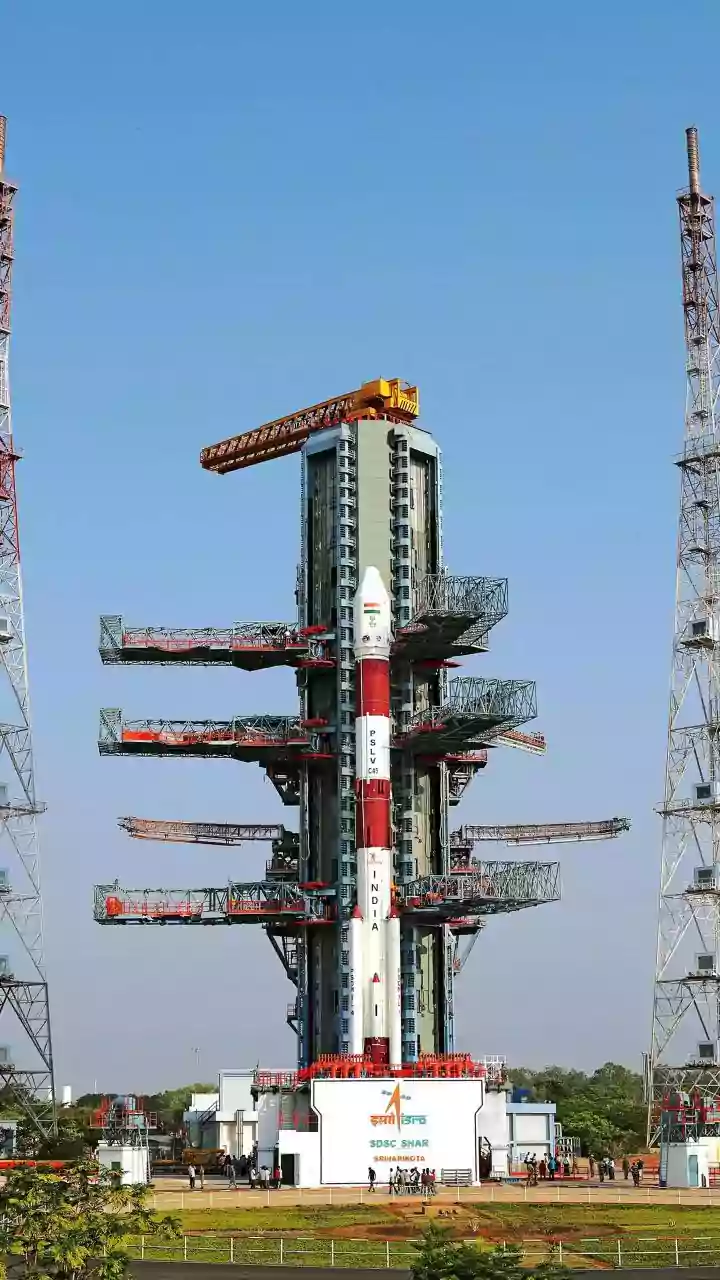
This is where India comes in. The Indian Space Research Organisation (ISRO), in collaboration with other institutions, is aggressively pursuing satellite-based quantum communication. After successfully demonstrating free-space QKD on the ground over 300 meters—including using it for a secure video conference—ISRO is now preparing to take the technology to orbit. The goal is to establish secure communication between ground stations hundreds or even thousands of kilometers apart. This effort is a central pillar of India's National Quantum Mission, a government initiative launched in 2023 with over $700 million in funding to make the country a global leader in quantum technologies. The mission has ambitious targets, including deploying a satellite-based secure communication network within India and eventually with other countries.
More Than Just a Tech Race
India's push into quantum-secure satellites is about more than just scientific achievement; it's a calculated geopolitical move. The global quantum race has largely been dominated by the U.S. and China, which launched the world's first quantum satellite, Micius, back in 2016. For India, developing its own sovereign capability is a matter of strategic autonomy. It wants to secure its critical infrastructure—from military and government communications to its vast digital finance and biometric identity systems—without relying on foreign technology. Success would not only protect India from future cyber threats but also position it as a key technological power and a potential partner for the United States and other democracies. As the world braces for an era where digital walls can no longer be trusted, India is building its defenses in the sky, staking its claim in the future of global security.