





Light's Powerful Role in Your Body
Our bodies run on a natural 24-hour internal clock called the circadian rhythm, which tells us when to feel sleepy and when to be alert. This clock is primarily set by light. Exposure to bright, natural light during the day reinforces this rhythm, promoting
wakefulness and boosting mood. Conversely, darkness signals the brain to produce melatonin, the hormone that helps us sleep. However, modern life, with its constant exposure to artificial light well after sunset, can disrupt this delicate cycle. Exposure to bright, and especially blue-toned, light in the evening from screens and overhead fixtures can suppress melatonin production, making it harder to fall asleep and reducing sleep quality. This disruption has been linked to issues beyond just tiredness; it can affect mood, stress levels, and overall well-being.
What is Smart Ambient Lighting?
This is where 'human-centric lighting' comes into play, a design philosophy that uses artificial light to support our biological needs. Smart ambient lighting is the practical application of this idea. Unlike a standard bulb with a single brightness and colour, smart lights can be controlled and automated. The key feature is 'tunable' light, which allows you to change both the intensity (brightness) and the colour temperature. Colour temperature is measured in Kelvin (K) and ranges from warm (yellow/orange tones, around 2700K) to cool (white/blue tones, 4000K and above). This ability to adjust the light to mimic the natural progression of the sun throughout the day is what makes it such a powerful tool for wellness.
Regulating Sleep with Light
The most significant benefit of smart lighting is its ability to help regulate your sleep cycle. By automating your lights, you can create a personal sunrise and sunset that aligns with your body clock. In the evening, about two hours before bed, you can schedule your lights to gradually dim and shift to warmer, amber tones. This transition signals to your brain that the day is ending, allowing for natural melatonin production to begin, which helps you wind down and feel sleepy. For waking up, you can reverse the process. Instead of a jarring alarm, a smart light can simulate a sunrise, slowly increasing in brightness and shifting from warm to cooler light over 30-45 minutes. This gentle awakening can help you feel more refreshed and alert.
Crafting Your Mood with Colour
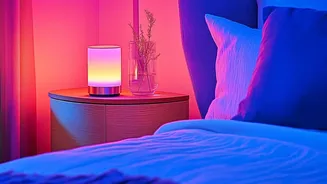
Light doesn't just affect our sleep; it has a direct impact on our mood and energy levels. Different light settings can create distinct atmospheres. Bright, cool-toned light is excellent for daytime focus and productivity, mimicking the effects of peak daylight to enhance alertness. This makes it ideal for a home office area or the kitchen in the morning. In contrast, warm, dim lighting promotes relaxation and a sense of comfort, perfect for unwinding in the evening. Studies suggest that warmer light can make a space feel more intimate and inviting, encouraging social connection. With smart lighting, you can create 'scenes' for different activities — a 'Focus' scene with cool light for work, a 'Relax' scene with warm light for reading, or even colourful scenes for entertainment.
Lighting Tips for Compact Apartments
In smaller homes, lighting can do double duty. Smart lighting can help define zones without walls. For instance, you can have a cool, bright light over a desk area while keeping the adjacent seating area in a softer, warmer glow. This visually separates the 'work' zone from the 'relax' zone. Using vertical light (e.g., floor lamps that wash walls with light) can also create an illusion of height and space. Another strategy is to use task lighting effectively. A focused, bright light for reading or cooking prevents you from having to flood the entire apartment with harsh overhead light, allowing other areas to remain softly lit for ambiance. Smart strip lights behind a TV, under cabinets, or along shelves can add depth and a modern feel without taking up any surface area.